fears etiketine sahip kayıtlar gösteriliyor. Tüm kayıtları göster

30 Aralık 2016 Cuma

"I exercise a lot but drink a bit too much": middle-aged readers" health fears

The government has launched a new health drive aimed at 40- to 60-year-olds, 83% of whom are either overweight, drink too much or are physically inactive.


With its One You campaign, Public Health England wants to help middle-aged people stay in shape. It says aspects of modern life – such as sedentary lifestyles and the consumption of junk food – are bad for our health, but it is those in middle age who are suffering the consequences most.


We asked our readers what they thought of the campaign and whether they had any concerns about their own lifestyles. Here’s what you told us.


Caroline, 58, from Essex: ‘There’s no incentive to lose weight when everyone you see is bigger than you’



Caroline sarychkin

I feel like I am generally in good health despite having an underactive thyroid and high cholesterol (I take medication for both these things). My weight is creeping up, however, which aggravates my arthritic knee – the legacy of a motorcycle accident in my 20s. My New Year resolution is to do more walking. I’ve got borderline osteoporosis, a condition that weakens bones, so know it’s important to build bone density, but having a desk job makes this hard.


I know I am overweight at 5ft 4in and 11st, but a lot of people are bigger than me and tell me I am “slim”. My clothes size has not changed over the years: I still wear a size 12, the same as when I was a teenager. There is no incentive to lose weight if nearly everyone you see is bigger than you.


I doubt that the One You campaign will make much of a difference. We all know we should eat healthier, be active and drink and smoke less but how many people who don’t do this already will really be bothered to change?


Kevin Varney, 49, from Reading: ‘I exercise a lot, but drink a bit too much’



Kevin Varney

My health is pretty good at the moment. My body mass index is not much over 25. I exercise quite a lot, but I drink a bit too much. I probably drink about 14 pints, sometimes a small bottle of wine and two or three mixer tins – for example, of gin and tonic – a week.


I do worry about it a bit. If I am socialising with friends, that will involve drinking, but if I am on my own at the weekend, I will drink too. However, I am suspicious of medical guidelines. I suspect there is a puritanical element or a wide safety margin in them. I suspect the government would like to ban alcohol altogether if they could.


I am surprised by the rates of inactivity reported recently – it should be possible to fit in some exercise while working. You can cycle to work, jog over lunch or head to the gym in the evening. I suspect a lot of people just hate exercise. I don’t think a campaign to change this will help. People are constantly being told they are too fat and don’t take enough exercise. Telling them again won’t make much difference.


Gita Bapat, 51, from London: ‘Long working and commuting hours make it harder to stay in shape’


I’ve never smoked (inherited asthma) and am a moderate drinker – around 5-6 units a week – but I am about 1st overweight. This is my main concern as I am quite vain. I have dogs and walk them most days for around an hour and a half. I am also trying to start running again. When I lived in Paris I ran 25km a week. My goal is to run 5km three times a week.


Modern lifestyles – long working and commuting hours – make it harder to stay in shape, as do care obligations, such as looking after children and older people. It’s easy to feel a sense of hopelessness if one cannot live up to the unrealistic and Photoshopped standards of people portrayed in the media.


Medi Parry, 59, from north Wales: ‘I want to be active, self-sufficient and healthy as I get older’



medi parry

We are living longer and I don’t want to be one of those elderly women who can’t do anything for themselves. I want to enjoy as much life as possible with my daughters and their families. I am an independent heritage consultant and want to keep working for as long as I can. I want to be active, self-sufficient and healthy as I age. I try to keep fit but hate the gym. I like to cycle but there are no cycle paths near where I live. I exercise by using the stairs where possible. I also jog in the kitchen while I’m waiting for the kettle to boil and go to a Zumba class once a week.


It’s not just modern lifestyles that make it hard to stay fit. The easy availability of high-calorie food also makes it difficult. Chocolates, sweets, pizzas and takeaways – they’re all too easy to get hold of and it’s hard not to eat them when you’ve been working hard all week. Our love of the internet means that we sit down for hours on end to engage with it; work is far more internet-based now and so more of us are tied to our desks for hours.


I’m not sure whether this campaign will work, it depends how it’s done. GPs find it difficult to broach the subject of weight with their patients as they mostly respond negatively (I have GP friends who confirm this – one has been reported for having “offended” his patient). It’s a good idea to flag up this research, and a preventative campaign should be more cost-effective than dealing with the long-term consequences of obesity in old age. However, I’m sceptical of the impact of this campaign unless it is backed up by some sort of legislation. The NHS has been running smoking cessation campaigns for decades but smoking has only really lessened following the ban in public areas.


Alex Dean, 40, from Kent: ‘I try not to drink during the week but usually buy a bottle of red on Friday’



Alex Dean

I don’t worry about my health but I do limit the amount I drink, I exercise and only eat healthy low-sugar foods. I don’t think modern lifestyles are to blame for the rise in obesity. I have two young kids, work in an office and have a minimum 15-hour commute each week but still find the time to exercise. It is a state of mind.


I have always been aware of my health and enjoyed walking and climbing, but last year I stepped it up and did my first triathlon. Having a date set for that (I gave myself six months to train) really helped me achieve my goal. Also taking on three new sports, especially swimming, was really beneficial – I gained a lot from the learning process. I loved completing the triathlon and have already booked myself into a longer one for next year. Again having “an event” was something to aim for. I regularly got out and trained.


I am not sure whether the campaign will work but it’s good to try something. I also believe schools play a big role and we need to educate on the importance of fitness from a young age.


I try not to drink during the week but usually buy a bottle of red on Friday. I drink it over Friday and Saturday night. Not having drink in the house for the rest of the week makes it easier to manage for me. I’ve managed to cut down by knowing my wife does not like it if I am drunk or drinking too much. I also think it would negatively affect my health and motivation if I drank more.


"I exercise a lot but drink a bit too much": middle-aged readers" health fears

31 Ekim 2016 Pazartesi

Childline anxiety calls spike as children express fears over global events

The number of children seeking help for anxiety has risen sharply in the last year, a leading charity has said, with increased exposure to global affairs on social media suggested as a possible cause.


The NSPCC’s Childline service handled 11,706 counselling sessions for anxiety over the past year, a 35% increase on 2014-15. The charity said: “Worryingly the problem appears to be getting worse.” It dealt with 6,500 contacts in the last six months where anxiety was cited the main issue – an average of 1,000 a month or 36 a day.


Research showed an increasing number of children and young people were concerned about world affairs such as the EU referendum, the US election and the conflict in Syria.


Childline figures

The rise is said to be down to a combination of personal and political issues, with some young people talking to counsellors about problems in their day-to-day life, while others cited disturbing events seen in the media and on social media as being the source of their worries, the charity said.


As Childline marks its 30th anniversary, it has created a webpage, launched in September, called Worries about the world, which has already received almost 5,000 visits.


Childline’s president, Esther Rantzen, said: “Seeing pictures of crying and bewildered toddlers being pulled from bomb-damaged homes upsets all of us. Often we fail to notice the impact these stories are having on young people.”


She said the fact they turned to Childline enabled them to express their anxiety. “Sometimes these stories also reveal related concerns in their own lives, such as being subjected to racist bullying.”


Being listened to and reassured, she said, meant if they suffer from other problems, “such as abuse or neglect, self-harm or cyberbullying, they will also turn to us for help”.


Esther Rantzen meeting volunteers at the NSPCC’s Glasgow office


Esther Rantzen meeting volunteers at the NSPCC’s Glasgow office. Photograph: Julie Howden/PA

Peter Wanless, the chief executive of the NSPCC, said: “The world can be a worrying place but we need to ensure our children are reassured rather than left overwhelmed and frightened.


“It’s only natural for children and young people to feel worried sometimes, but when they are plagued by constant fears that are resulting in panic attacks and making them not want to leave the house then they need support.”


Children as young as eight have contacted Childline to talk about their fears, with girls seven times more likely to get in touch for help with anxiety than boys.


There has been a marked shift in how the service is used. More than two-thirds of users now communicate with counsellors online.


Children and young people can contact Childline for free, confidential support and advice, 24 hours a day on 0800 1111 or at childline.org.uk.


Childline anxiety calls spike as children express fears over global events

23 Ağustos 2016 Salı

Puerto Rico officials struggle to translate Zika virus fears into action

Every time it rains in San Juan, Dr Brenda Rivera-Garcia walks around her home emptying containers of standing water, likely wearing long sleeves, and almost certainly wearing mosquito repellant. Rivera-Garcia is the state epidemiologist in Puerto Rico, a woman tasked with tracking every single Zika-infected pregnant woman in the US territory.


Less than two weeks after the US health and human services administration declared the spread of Zika on the island an epidemic, Rivera-Garcia said it’s not frustration or anger that overtakes her when she adds a new woman’s name to a list of roughly 700 confirmed to be infected with the disease.


It’s sadness.


“Every time I have to add a pregnant woman to that list, I just think of what’s going to be of this pregnancy,” she said, her eyes visibly wet. “What’s going to be of this child later on, and, it’s, it’s – it breaks my heart.”


As much as 25% of the island’s population could have the disease by the end of mosquito season, the Centers for Disease Control and Prevention estimates, and up to 50 pregnant women each day are infected on the island.


A recent study projected as many as 270 babies could be born with the debilitating birth defect microcephaly, between now and mid-2017. In a normal year, doctors expect 16.


The defect causes infants of mothers infected with the virus to be born with abnormally small heads, and suffer life-long developmental disorders. Some will have trouble walking. Others may have hearing or vision loss, trouble swallowing or seizures. Many are likely to have shortened life expectancy.


But health officials have had difficulty translating those projections into urgency among many Puerto Rico residents, who have been dogged in the past by tropical diseases with more apparent symptoms, such as Dengue and Chikungunya. Indeed, the government’s efforts to control the virus seem hampered at every turn, thwarted by apathy, lack of trust, misinformation, insecticide resistance and even architecture.


“The system doesn’t work so of course people are going to be skeptical,” said Joe Torra, 40, a professional driver in San Juan.


Referencing colonialism, Torra said: “The best way to control minds is to control bodies.”


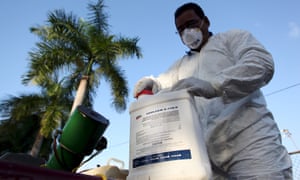
A health worker prepares insecticide before fumigating a neighborhood in San Juan on 27 January 2016.


A health worker prepares insecticide before fumigating a neighborhood in San Juan on 27 January 2016. Photograph: Alvin Baez / Reuters/Reuters

‘False alarms’


Denisse Velazquez, 36, stood under the shade of a tree in Old San Juan, one of the hardest hit municipalities, as she said that the government “created false alarms”.


Juan Martinez, 43, said that with “all these diseases we have seen, it’s something normal”, referring to periodic outbreaks of Dengue the island has struggled with since the 1980s, and the recent Chikungunya outbreak. “In the Caribbean there has always been mosquitoes.”


Even tourism officials have reinforced the view that Zika risk has been overblown.


“From the very beginning the numbers that were given were based on projections. The reality is that as of today, less than half of 1% of the population has the virus,” Clarisa Jimenez, CEO of the Puerto Rico Hotel and Tourism Association, told CNBC’s Squakbox. “The only issue here is if you’re pregnant.”


Jimenez focused on the roughly 10,600 Puerto Ricans who had, at the time, been diagnosed with Zika by the CDC. The figure is an underestimate, because four out five infected people have no symptoms and likely do not know they are ill.


Now, near the end of August, the health department of Puerto Rico and the CDC have diagnosed 12,800 Zika infections, including more than 670 in pregnant women, believed to represent only a fraction of actual infections.


So far, only one child has been born with microcephaly. But experts expect that number to increase dramatically in coming months, particularly from September to December.


Health professionals believe the most dangerous time for a pregnant woman to be infected is in her first trimester, though more research is needed. Those pregnancies are expected to begin coming to term this fall.


“Right now, most of the births we have seen are among second and third trimester infections,” said Rivera-Garcia. “For us, it’s not just a number. There’s a family behind that number.” Doctors suspect that even these cases, which are less dramatic in appearance, could result in problems that won’t manifest until much later.


The island’s timetable of epidemic infection is about one year behind Brazil’s. In December 2015, as cases of microcephaly began to surge in Brazil, cases of locally acquired infections were just beginning to show up in Puerto Rico.


“When you’re involved in major epidemics, and particularly this one for some reason, I’ve been unable to disconnect,” said Dr Francisco Alvarado-Ramy, a senior CDC official and native Puerto Rican who helps lead the federal government’s response to the epidemic. He is stationed at the Dengue Branch, an outpost in San Juan established to combat another virus spread by the same mosquito as Zika, the aggressive Aedes aegypti.


“The moment that I go to the sleep to the moment that I wake up, my mind seems to be around Zika all the time, trying to think if there’s any other thing we can do,” he said.


“When something goes wrong, it’s also a very fast way down, downstairs in terms of your emotional well-being. We’re trying to prepare our staff, as well, if we start seeing a lot of people with bad outcomes how to handle that emotionally.”


Employees with the municipal government collect used tires on 7 August 2016 in the Rio Piedras section of San Juan, Puerto Rico.


Employees with the municipal government collect used tires on 7 August 2016 in the Rio Piedras section of San Juan, Puerto Rico. Photograph: Angel Valentin/Getty Images

Cat, Dog, Mosquito


“We have in Puerto Rico a dog, a cat and a mosquito,” said Carmen Deseda, the former state epidemiologist who battled several epidemics of Dengue, a hemorrhagic fever that can incapacitate a person for weeks. “The problem is not the mosquito, it’s the virus.”


Deseda expressed a view common among Puerto Ricans: the mosquito is here to stay, fumigating won’t work, so the government better find some other way to deal with this.


She was among many prominent opponents of fumigating the island with an insecticide called Naled, a solution proposed by the CDC and used on about 6m acres of land each year in Florida. Many residents were outraged that the federal government would, in their view without permission, spray chemicals over the island.


“When they said that I was very upset,” said Miguel Pellot, 48, the owner of a smoothie stand called Fruta Fruit in San Juan. “¿Como se dice, una falta de respeta?” he said, asking how to express lack of respect in English.


“For people here, this is nothing new. We’ve had mosquitoes here since we were born,” Deseda said. “They don’t feel threatened by the mosquito, because it’s been always with them.”


Deseda said government fumigation encourages apathy among the population. “The government is doing something so they don’t have to anything.”


Ceda Velez, a 36-year-old woman working a juice stand near San Juan’s cruise ship ports said she was in favor of government fumigation.


“We use repellant, but at least it would help with where the mosquitoes breed, to kill the mosquitoes,” she said in Spanish. “I worry.”


Puerto Rico won’t fumigate with Naled from planes, as Florida does. And even if Puerto Rican authorities decided to fumigate street-side from trucks, only about 12 on the island are outfitted to spray for mosquitoes. Regional resistance to insecticides has also confounded eradication efforts.


Some residents believe the island was a guinea pig for past federal government experiments, that Zika was mild and posed no risk, that they weren’t going to stop “living”, or were simply misinformed about how to prevent exposure.


“I had, yes, but I drink Tylenol, y ya,” said Naara Nieves, 39, who stood outside at noon in San Juan proselytizing, a gregarious evangelist of Jehovah’s Witness. “I think the women who are pregnant, is bad, but for me, no.”


Marylin Vigo, who was visiting her sister on the island from Brooklyn, New York, said her relatives called her “paranoid” for even slathering on mosquito repellent.


“She goes, ‘Ugh! That doesn’t mean you’re going to get Zika, because of mosquito bites,’” Vigo said, describing her sister’s reaction. This is despite her sister’s belief that Vigo’s 29-year-old nephew just contracted the virus.


A cultural gulf


One of the most cited differences between Puerto Rico and the mainland is the lack of screened windows and air conditioning, which hamper mosquito-borne diseases spread in places like Texas.


Tropical breezes course uninhibited through flung open doors, patios and unscreened louvre window shades. The open roofs of Spanish-influenced architecture let in rain drained away by a floor grate.


“If you go to the communities, people love to sit out on their patio, play dominoes, play music, have a barbecue, and that’s difficult to do in a screened in porch, or take advantage of the Caribbean leeward breezes,” said Rivera-Garcia. “It certainly changes your way of life.”


So the Puerto Rico Department of Health is focused on behavioral and cultural change.


River-Garcia said past epidemics of diseases with severe symptoms like Chikungunya have not driven people to engage in practices like wearing repellant and investing in screened windows.


“That’s why we – from the get-go in January – we said, ‘OK, we need behavioral science studies. We need to understand what will be that one driver, or the drivers, to effect behavior change.”


Even for those who might want screens, it could be a real burden.


Nearly half the population, 46%, lives in poverty. The average per capita income is just $ 19,600, making an air conditioned bedroom unattainable.


A raft of other science conducted on the island is looking at other solutions. Children of Zika-infected mothers will be followed until they are three years old. Alvarado and his team collect blood and placenta samples from Zika-infected women who give birth and miscarry.


Traps are being reengineered at the Dengue branch, including the promising, pesticide-free innovation of a bucket that uses fermenting hay and water to trap mosquitoes.


“It drives me to keep trying and see where can we improve, what else can we do,” said Rivera-Garcia. “I think for all the responders both local and stateside with many Puerto Ricans in various areas of expertise – they’re coming back, donating their time, or asking for deployments in Puerto Rico.”


Puerto Rico officials struggle to translate Zika virus fears into action

9 Ağustos 2016 Salı

Young men and body image: what are your biggest fears and insecurities?

Body image issues are typically seen to mainly affect young women, but a survey by an advertising think-tank has found young men can have just as many insecurities.


The survey by Credos of more than 1,000 secondary-school aged students, found 56% saw eating disorders as an issue for both genders and 55% would consider changing their diet to look better. What’s more, 23% said they believed there was a “perfect male body”.


Despite this, over half of those surveyed found it hard to talk about their concerns with teachers – and 29% struggled telling parents. The biggest influences on young men to look good come from friends, social media, advertising and celebrities, according to the survey.


We want to hear from young men about this, sharing with us your biggest worries and concerns. Do male teens focus on this issue just as much as girls? What is the “perfect male body” in your eyes? How much time do you spend exercising and dieting?


Share your experiences and views with us in the form below – and we will use responses for an article that will appear online.


As this is a sensitive topic, please be reassured that we will not share or publish any personal details without obtaining contributors’ permission first. You have to be over 16 to take part.


Young men and body image: what are your biggest fears and insecurities?

18 Ağustos 2015 Salı

Meningitis C vaccine shortage prompts fears of key outbreak in Africa

A shortage of meningitis C vaccine is threatening to jeopardise the potential to cope with a likely outbreak of the condition in Africa, global public well being organisations, such as the World Overall health Organisation, have warned.


A Meningitis A vaccine launched in 2010, MenAfriVac, has substantially lowered incidence of that strain but type C infections have been growing and a cheap equivalent that would shield against meningitis C, between other strains, is still many years away.


In the meantime, the members of the Global Coordinating Group for Vaccine Provision for Epidemic Meningitis Handle, which also comprises the Worldwide Federation of Red Cross and Red Crescent Societies (IFRC), and Médecins sans Frontières (MSF) are attractive to pharmaceutical firms to support them by plugging the gap.


Related: Meningitis vaccine withstands African heat with no injury


At existing, they say pharmaceutical businesses have advised them they are unable to provide the newer, a lot more efficient conjugate vaccines, which supply longer lasting immunisation than the outdated polysaccharide vaccines.


Dr William Perea, coordinator of the management of epidemic ailments unit at WHO, explained: “The issue is that now that we have vaccinated 200 million folks there are no far more epidemics with [meningitis] A, but this 12 months was a shock to us because we had been not expecting such a large one particular [meningitis C epidemic] as occurred in Niger.


“What we have told the companies is we want the conjugate vaccine to be ready to prevent epidemics for longer periods but they will not make the vaccine in ample quantities at affordable costs.”


As nicely as the further safety afforded by the conjugate vaccines, they are also ideal for kids, in contrast to the polysaccharide version. Even so, according to WHO figures, they usually value at least ten occasions far more than polysaccharide vaccines, which are priced at about $ 4 to $ five. Even with the producers providing the conjugate vaccines at $ 25 a dose, for the five million doses needed that amounts to $ 125m as opposed to $ 25m for the polysaccharide vaccines.


People gather at the health centre in Lazaret, near Niamey in Niger, in April 2015, where patients suffering from meningitis are being treated.
Folks collect at the well being clinic in Lazaret, near Niamey, Niger, in April 2015, the place sufferers struggling from meningitis are being treated. Photograph: Boureima Hama/AFP/Getty

“Either they assist us have affordable conjugate vaccines or we’ll have to use an previous vaccine that does not supply us with the identical quality,” mentioned Perea.


Meningitis C can trigger serious brain injury and is fatal in 50% of cases if untreated.


There were twelve,000 circumstances of meningitis in Niger and Nigeria and 800 deaths in the very first 6 months of the 12 months but with cases increasing because 2013, the fear is that subsequent year’s meningitis season, which starts in January, could see a considerably larger quantity of instances.


The MenAfriVac stockpile, brought about by way of a public-private partnership, was produced in response to an outbreak of meningitis A in sub-Saharan Africa in 1996-97 that developed 200,000 situations and 20,000 deaths.


It is as well early to say whether or not the C strain will behave in a similar style to A, moving to other nations in sub-Saharan Africa, but Perera mentioned the fact that it had already expanded from Nigeria to Niger in a couple of many years meant that this was a situation it was crucial to put together for.


MSF’s global healthcare coordinator, Dr Myriam Henkens, emphasised the importance of a multivalent vaccine – one particular that covers distinct strains of the illness: “We want vaccine makers to prepare manufacturing of a multivalent vaccine now to let ample lead time and capacity to meet this demand.”


A GSK spokeswoman confirmed the business had been in talks with the WHO and mentioned: “We are evaluating if and how we may possibly be in a position to supply further doses.”


Sanofi Pasteur said it was trying to improve production of its polysaccharide vaccine which covers Meningitis C.


Meningitis C vaccine shortage prompts fears of key outbreak in Africa

17 Ağustos 2015 Pazartesi

Young women steer clear of discussing sex with GP above fears of saying "vagina" and "orgasm"


Youthful ladies are staying away from medical aid simply because they are too embarrassed to go over gynaecological problems with their physicians, in accordance to a new examine.


Out of 1,000 women surveyed, those aged amongst 18-24 had been four times significantly less likely to go to a medical professional about a sexual wellness issue than females aged in between fifty five-64.


Two thirds of youthful females said they’re be embarrassed to say the word ‘vagina’, or ‘orgasm’ to their medical professional.


A lot more than half have been self-conscious about saying ‘discharge’ although 60 per cent didn’t want to say ‘labia’.


A quarter of younger girls averted their physician purely because they did not know what phrases to use, while 44 per cent did so out of a reluctant to talk about sexual well being concerns.


• Catch ovarian cancer before the disease catches you


Virtually half have been so scared of getting intimately examined that they didn’t go to the physician.


British charity Ovarian Cancer Action, which commissioned the survey, located 57 per cent of younger women have been turning to Google rather of their GP.


Just 17 per cent would seek out health-related aid if they had any gynaecological signs, in contrast to 68 per cent of older females.


Katherine Taylor, acting chief executive at Ovarian Cancer Action, mentioned: “The reluctance to see a medical doctor for gynaecological issues is really worrying and, while numerous of us have turned to the world wide web for help, googling symptoms is not a substitute for correct health care consideration.


“Illnesses this kind of as ovarian cancer – which kills a female every single two hours in the United kingdom – is considerably less difficult to treat if it’s diagnosed early, so it is extremely important that ladies really feel empowered to speak about their well being and truly feel cozy visiting healthcare specialists.


“We really don’t want to be scaremongers – ovarian cancer is fairly unusual in younger girls – but we do want to motivate ladies to speak about gynaecological health and aid spread awareness of the signs of ovarian cancer. These are, persistent bloating, peeing a lot more typically, persistent tummy soreness and feeling total far more rapidly.


“It’s so essential that females are empowered to discuss these concerns. Saying ‘vagina’ will not destroy you, but staying away from saying it could.”


Much more than a third of young ladies were unable to recognize a symptom of ovarian cancer, and only 11 per cent stated realizing their family members historical past would inspire them to look for tips – even however twenty per cent of ovarian cancers are a end result of a genetic predisposition.


Ovarian cancer is the most deadly gynaecological cancer and at the moment the fifth most frequent cancer between ladies.


There are 7,000 new diagnoses every single 12 months right here in the Uk – and we have one particular of the lowest survival charges in Western Europe, with a girl dying from ovarian cancer each and every two hours, which quantities to four,300 deaths each and every year.


• Improve in number of younger British women currently being diagnosed with cervical cancer


‘I had ovarian cancer aged 19’


Ellie Cohen, 23Ellie Cohen, 23


Ellie Cohen, 23, from London stated: “I was diagnosed with ovarian cancer when I was just 19 and it turned my existence upside down. I had to leave uni so I could have chemotherapy close to my parents’ home in London.


“It took a even though to get a diagnosis, almost certainly since I was so youthful. No person suspected cancer.


“Although I am performing nicely now, this knowledge has genuinely taught me the importance of speaking up about overall health troubles. It’s so essential that we pay attention to our bodies and don’t let shyness hold us back – it’s assured that the medical professional has heard it all ahead of anyway.


“Now, if I come to feel the slightest twinge, I’m back to the medical professionals. That’s what saved my daily life final time and, as the previous adage goes, it’s far better to be risk-free than sorry.”


Young women steer clear of discussing sex with GP above fears of saying "vagina" and "orgasm"

18 Temmuz 2014 Cuma

Breakthrough created in quest for new malaria medicines as resistance fears expand

Australian researchers have created a significant breakthrough in the race to discover new medicines to eliminate malaria, as resistance increases to the only drug left to treat the ailment.


Scientists from the Burnet Institute, Deakin University and Monash University were in a position to starve the malaria parasite of crucial proteins important to its survival, delivering a target for the improvement of new antimalarial drugs.


The malaria parasite exists inside a red blood cell – which permits it to go undetected by the immune technique, but is not an excellent atmosphere for the parasite to expand and thrive.


A co-writer of the paper, published in Nature, Tania de Koning-Ward from Deakin’s medical school, stated it meant the parasite had to “renovate” its setting by sending hundreds of its own proteins into the red blood cell for it to feed on.


“What our study has proven is individuals proteins can only get accessibility to the red blood cell via one gateway, which provides a channel for the proteins to get into the red blood cell so that it can reside and multiply,” she explained.


“We managed to alter the perform of this gateway so that these proteins can no longer get into the red blood cells, starving and killing the parasite.”


In 2009 researchers first discovered the malaria parasite obtained the proteins it essential by means of a gateway. But they were unsure whether blocking that gateway meant the parasite would basically uncover one more one. Parasites are notoriously great at adapting.


That meant convincing drug companies to invest in establishing medication to block the gateway had been a hard sell till now, De Koning-Ward explained.


“What we have shown by way of this analysis is the parasite utilizes just this a single gateway to acquire these proteins, which makes that gateway a excellent target for drug therapies.”


As parasites create resistance to drugs, researchers usually tweak them slightly to make them tougher for the parasite to battle. But the parasite often speedily develops resistance to the newer versions.


Artemisinin – the only drug left to deal with malaria – and the drug that came just before it, chloroquine, the two worked by offering the malaria parasite what was primarily a negative situation of indigestion, avoiding it from being able to eradicate a construct-up of iron that takes place right after it ingests haemoglobin.


Another co-author of the review, Dr Paul Gilson, senior investigation officer at Burnet Institute, stated the new research meant drug firms could now change their tactic totally. Alternatively of blocking the parasite’s capacity to detoxify the iron ingested, they could target the gateway it employed to get the “food”.


“It implies that when a drug that blocks the gateway is created, it may possibly get a whole lot longer for the malaria parasite to develop resistance to it, since it will never ever have witnessed a drug like this just before,” he said.


Resistance to artemisinin has previously occurred in parts of south-east Asia.


Gilson believes medicines that target the gateway could be prepared inside a few years, but explained they would then want to undergo trials that could get up to an additional ten many years.


“But the cupboard of medication obtainable to treat malaria is at present quite bare,” Gilson stated. “Our study supplies an critical new target for drug development.”


Malaria is spread via mosquitoes and its most lethal form is caused by the parasite plasmodium falciparum. More than 200 million people get malaria each and every 12 months and far more than half a million of those, mostly young children, die from the illness.


The speedy development in population movements meant there was a chance resistant malaria might reach other countries more speedily, Gilson explained. Whilst resistant malaria is not impossible to treat, it takes a whole lot longer.


Breakthrough created in quest for new malaria medicines as resistance fears expand

17 Temmuz 2014 Perşembe

Breakthrough made in quest for new malaria medicines as resistance fears expand

Australian researchers have created a significant breakthrough in the race to discover new medicines to remove malaria, as resistance increases to the only drug left to deal with the disease.


Scientists from the Burnet Institute, Deakin University and Monash University were ready to starve the malaria parasite of essential proteins important to its survival, offering a target for the growth of new antimalarial medication.


The malaria parasite exists within a red blood cell – which enables it to go undetected by the immune program, but is not an excellent setting for the parasite to grow and thrive.


A co-writer of the paper, published in Nature, Tania de Koning-Ward from Deakin’s medical school, said it meant the parasite had to “renovate” its environment by sending hundreds of its own proteins into the red blood cell for it to feed on.


“What our analysis has proven is those proteins can only get access to the red blood cell via a single gateway, which supplies a channel for the proteins to get into the red blood cell so that it can live and multiply,” she mentioned.


“We managed to alter the perform of this gateway so that these proteins can no longer get into the red blood cells, starving and killing the parasite.”


In 2009 researchers initial found the malaria parasite obtained the proteins it necessary via a gateway. But they have been uncertain regardless of whether blocking that gateway meant the parasite would merely uncover another one particular. Parasites are notoriously great at adapting.


That meant convincing drug organizations to invest in establishing drugs to block the gateway had been a difficult sell right up until now, De Koning-Ward stated.


“What we have proven via this investigation is the parasite utilizes just this one gateway to obtain these proteins, which helps make that gateway a excellent target for drug remedies.”


As parasites build resistance to medication, researchers usually tweak them somewhat to make them more difficult for the parasite to battle. But the parasite typically quickly develops resistance to the newer versions.


Artemisinin – the only drug left to treat malaria – and the drug that came prior to it, chloroquine, both worked by providing the malaria parasite what was primarily a poor case of indigestion, stopping it from currently being in a position to remove a develop-up of iron that happens soon after it ingests haemoglobin.


Yet another co-writer of the review, Dr Paul Gilson, senior research officer at Burnet Institute, stated the new analysis meant drug companies could now alter their tactic entirely. Rather of blocking the parasite’s capability to detoxify the iron ingested, they could target the gateway it utilized to get the “food”.


“It indicates that when a drug that blocks the gateway is developed, it could get a good deal longer for the malaria parasite to develop resistance to it, due to the fact it will never have noticed a drug like this ahead of,” he stated.


Resistance to artemisinin has presently occurred in elements of south-east Asia.


Gilson believes drugs that target the gateway could be ready inside a few years, but explained they would then need to undergo trials that could take up to another 10 many years.


“But the cupboard of medicines offered to deal with malaria is at the moment rather bare,” Gilson said. “Our investigation provides an essential new emphasis for drug development.”


Malaria is spread through mosquitoes and its most lethal kind is induced by the parasite plasmodium falciparum. Far more than 200 million people get malaria every year and more than half a million of those, mostly youngsters, die from the illness.


The quick development in population movements meant there was a risk resistant malaria may possibly attain other nations more swiftly, Gilson explained. Even though resistant malaria is not unattainable to deal with, it takes a great deal longer.


Breakthrough made in quest for new malaria medicines as resistance fears expand

16 Temmuz 2014 Çarşamba

Breakthrough produced in quest for new malaria medicines as resistance fears expand

Australian researchers have manufactured a main breakthrough in the race to uncover new medicines to remove malaria, as resistance increases to the only drug left to deal with the condition.


Scientists from the Burnet Institute, Deakin University and Monash University had been in a position to starve the malaria parasite of crucial proteins vital to its survival, supplying a target for the growth of new antimalarial medicines.


The malaria parasite exists within a red blood cell – which permits it to go undetected by the immune program, but is not an best environment for the parasite to grow and thrive.


A co-writer of the paper, published in Nature, Tania de Koning-Ward from Deakin’s health-related college, mentioned it meant the parasite had to “renovate” its setting by sending hundreds of its own proteins into the red blood cell for it to feed on.


“What our analysis has proven is people proteins can only get entry to the red blood cell by means of 1 gateway, which offers a channel for the proteins to get into the red blood cell so that it can dwell and multiply,” she explained.


“We managed to alter the perform of this gateway so that these proteins can no longer get into the red blood cells, starving and killing the parasite.”


In 2009 researchers first discovered the malaria parasite obtained the proteins it needed via a gateway. But they have been uncertain regardless of whether blocking that gateway meant the parasite would just uncover an additional one. Parasites are notoriously excellent at adapting.


That meant convincing drug businesses to invest in developing medication to block the gateway had been a challenging sell until finally now, De Koning-Ward mentioned.


“What we have shown through this analysis is the parasite makes use of just this a single gateway to obtain these proteins, which makes that gateway a fantastic target for drug treatment options.”


As parasites develop resistance to drugs, researchers usually tweak them slightly to make them harder for the parasite to battle. But the parasite usually swiftly develops resistance to the newer versions.


Artemisinin – the only drug left to deal with malaria – and the drug that came prior to it, chloroquine, the two worked by offering the malaria parasite what was in essence a bad situation of indigestion, avoiding it from being ready to eliminate a build-up of iron that occurs following it ingests haemoglobin.


Another co-author of the review, Dr Paul Gilson, senior study officer at Burnet Institute, mentioned the new research meant drug firms could now adjust their tactic completely. As an alternative of blocking the parasite’s capacity to detoxify the iron ingested, they could target the gateway it utilized to get the “food”.


“It signifies that when a drug that blocks the gateway is produced, it may take a good deal longer for the malaria parasite to develop resistance to it, simply because it will in no way have observed a drug like this prior to,” he mentioned.


Resistance to artemisinin has previously occurred in parts of south-east Asia.


Gilson believes medicines that target the gateway could be ready inside of a couple of years, but stated they would then want to undergo trials that could take up to yet another ten many years.


“But the cupboard of drugs offered to deal with malaria is currently rather bare,” Gilson said. “Our study supplies an important new concentrate for drug development.”


Malaria is spread through mosquitoes and its most lethal form is induced by the parasite plasmodium falciparum. Much more than 200 million folks get malaria every year and much more than half a million of people, mainly children, die from the condition.


The fast development in population movements meant there was a danger resistant malaria may well attain other countries a lot more speedily, Gilson mentioned. Although resistant malaria is not unattainable to treat, it requires a whole lot longer.


Breakthrough produced in quest for new malaria medicines as resistance fears expand

Breakthrough produced in quest for new malaria drugs as resistance fears increase

Australian researchers have created a key breakthrough in the race to locate new medicines to remove malaria, as resistance increases to the only drug left to deal with the illness.


Scientists from the Burnet Institute, Deakin University and Monash University were capable to starve the malaria parasite of important proteins vital to its survival, providing a target for the growth of new antimalarial drugs.


The malaria parasite exists within a red blood cell – which makes it possible for it to go undetected by the immune technique, but is not an ideal environment for the parasite to develop and thrive.


A co-writer of the paper, published in Nature, Tania de Koning-Ward from Deakin’s health care school, explained it meant the parasite had to “renovate” its surroundings by sending hundreds of its personal proteins into the red blood cell for it to feed on.


“What our analysis has proven is these proteins can only get entry to the red blood cell by way of 1 gateway, which offers a channel for the proteins to get into the red blood cell so that it can live and multiply,” she explained.


“We managed to alter the perform of this gateway so that these proteins can no longer get into the red blood cells, starving and killing the parasite.”


In 2009 researchers very first found the malaria parasite obtained the proteins it essential by means of a gateway. But they had been uncertain regardless of whether blocking that gateway meant the parasite would basically find yet another one. Parasites are notoriously good at adapting.


That meant convincing drug organizations to invest in developing medication to block the gateway had been a hard sell until finally now, De Koning-Ward said.


“What we have shown via this study is the parasite employs just this one gateway to obtain those proteins, which tends to make that gateway a excellent target for drug therapies.”


As parasites create resistance to medicines, researchers often tweak them somewhat to make them harder for the parasite to fight. But the parasite frequently quickly develops resistance to the newer versions.


Artemisinin – the only drug left to treat malaria – and the drug that came prior to it, chloroquine, both worked by giving the malaria parasite what was basically a negative situation of indigestion, preventing it from currently being in a position to remove a develop-up of iron that occurs soon after it ingests haemoglobin.


One more co-writer of the examine, Dr Paul Gilson, senior analysis officer at Burnet Institute, stated the new research meant drug organizations could now modify their tactic fully. As an alternative of blocking the parasite’s ability to detoxify the iron ingested, they could target the gateway it utilised to get the “food”.


“It signifies that when a drug that blocks the gateway is designed, it may take a great deal longer for the malaria parasite to produce resistance to it, because it will by no means have seen a drug like this ahead of,” he explained.


Resistance to artemisinin has already occurred in components of south-east Asia.


Gilson believes medication that target the gateway could be ready inside of a handful of years, but said they would then need to have to undergo trials that could take up to yet another ten many years.


“But the cupboard of medication accessible to deal with malaria is at present fairly bare,” Gilson explained. “Our research offers an essential new target for drug growth.”


Malaria is spread via mosquitoes and its most lethal form is brought on by the parasite plasmodium falciparum. Much more than 200 million people get malaria every single yr and a lot more than half a million of these, mainly youngsters, die from the disease.


The fast development in population movements meant there was a threat resistant malaria may possibly attain other nations a lot more speedily, Gilson stated. While resistant malaria is not not possible to deal with, it requires a lot longer.


Breakthrough produced in quest for new malaria drugs as resistance fears increase

8 Temmuz 2014 Salı

The New York Occasions Revisits The "Debate" In excess of Electromagnetic Fields, Reviving Baseless Fears, While Ignoring What Has Been Learned

Yesterday, in its Science Occasions section, the New York Times published a piece by Kenneth Chang titled “Debate Continues on Hazards of Electromagnetic Waves.”   The report appears below a new heading “Time Travel,” an occasional column that “explores subjects covered in the Science Times 25 many years ago to see what has altered – and what has not.”


To match the new format, Chang referred to a Science Occasions post from 1989 that talked about the achievable adverse overall health effects from electromagnetic fields (EMF) produced by power lines, electrical appliances and machinery, and wiring in the home.


Even so, in actuality this situation came to prominence 10 many years earlier, when an post was published claiming that young children who lived near electrical power lines were twice as probably to die of cancer as children who had been not exposed.


This research was the catalyst for many additional scientific studies above the following three decades, and many assessments by scientific organizations and wellness agencies.  As a outcome we have actually discovered anything about EMF.


Friends meet and chat, using a cell phone to s...

Buddies meet and chat, utilizing a cell cellphone to say hi, Puerto Vallarta, Jalisco, Mexico (Photograph credit score: Wonderlane)


But Chang interviewed a professor of public well being David O. Carpenter, because he had been interviewed 25 many years in the past for the Science Instances article.  Carpenter has lengthy been voicing his concern about EMF, and he tells Chang, “The whole thing is very worrisome.  We see the guidelines of the iceberg, but we have no idea how large the iceberg is.  It ought to concern us all.”


According to Carpenter, “Almost absolutely nothing has altered in 25 many years in terms of the controversy, even though the evidence for biological effects of electromagnetic fields continues to increase stronger.”


As the report indicates, a lot of the concern has shifted away from the incredibly-minimal frequency EMF (ELF-EMF) from energy lines and appliances to the higher frequency radiofrequency (RF) waves utilised by cellular telephones and Wi-Fi.


By acquiring his update from Professor Carpenter, Chang is receiving a very skewed see of the pertinent proof that has accumulated in excess of the past decades.  Carpenter is related with the Bioinitiative Working Group, a fringe group whose members are convinced that the two varieties of waves (ELF-EMF and RF) are probably dangerous.


This view contrasts with that of any number of specialist organizations and well being agencies that have assessed the wellness results of ELF-EMF and radiofrequency power and found no steady or credible proof of a threat.  These incorporate: the American Bodily Society, the Nationwide Cancer Institute, the American Cancer Society American Cancer Society, the Nationwide Academy of Sciences, and the Global Commission on Non-Ionizing Radiation Protection.


People who look to have a vested interest in believing that EMF/RF are hazardous at the levels at which people are exposed in everyday life have a tendency to cite evidence that suits their argument.


Exactly where cell phones are concerned, they tend to cite a minority of epidemiologic research by a single study group in Sweden that seem to link use of mobile phones to enhanced threat of certain brain cancers.  But they ignore the significantly more substantial entire body of studies from all in excess of the globe which demonstrate no this kind of association.


They also disregard the fact that, in spite of the dramatic growth of cell mobile phone use over the past two decades, there has been no improve in brain cancers, either in the U.S., in Scandinavia, or elsewhere.


The believers also are quick to point to experimental studies that appear to show damaging results on cells.  However, it is usually difficult to know how the final results of this kind of studies – if appropriate – apply to complete organisms, and specifically to humans.


In 2011, the International Company for Analysis on Cancer assessed the evidence with regards to cell phones and basically located no experimental evidence supporting a role of this sort of vitality in the cancer method.  However, in an extra of caution, the agency labeled radiofrequency radiation a “possible carcinogen.”


As the Occasions article indicated, technology is evolving, and properly-created scientific studies ought to be conducted to check the results of its use.  But that is quite different from the mindset of these who select isolated, and probably anomalous, benefits in support of their conviction that power lines or cell phones are creating adverse well being effects.


The New York Occasions Revisits The "Debate" In excess of Electromagnetic Fields, Reviving Baseless Fears, While Ignoring What Has Been Learned

1 Temmuz 2014 Salı

Fears that attacks on statins could place lives at risk

The Nationwide Institute of Overall health and Care Excellence is due to publish ultimate suggestions on prescribing of statins later in July.


Draft proposals recommend cutting the “risk threshold” in half, meaning the vast bulk of men aged over 50 and most females more than the age of 60 would be recommended to get the medication to guard against strokes and heart condition.


Cardiologists and scientists stated the weight of evidence – like 27 clinical trials – demonstrated obviously that the advantages of the tablets outweigh any side-effects, even amongst individuals with a lower possibility of heart assault.


Significantly less than one per cent of patients would suffer side-effects, they explained, although those who took the drugs would normally lessen their threat of heart attack and stroke by 40 per cent.


Prof Adam Timmis, professor of clinical cardiology, Barts and the London NHS believe in, mentioned: “Even in very low-chance groups, the benefits of statins tremendously exceed any identified hazards.”


The group expressed concern that the public had been misled by claims – now withdrawn, after their publication in the BMJ – that 1 in five sufferers on the medicines suffers ill-results.


Prof Rory Collins, head of the Nuffield Department of Population Wellness at Oxford University explained it was frequent for older folks taking statins to suffer aches and pains, but trials had proven these had been just as typical in individuals not taking the drugs.


He said he felt “anxious” that individuals at higher chance of heart assault and stroke may well cease taking the drugs since they believed side-effects have been far higher than is the situation.


Prof Peter Weissberg, healthcare director of the British Heart Basis, stated: “The most significant threat to very good medication is prejudice, belief and anecdote.


“As human beings we are all influenced by our personalized experience. That’s why in medication we need aim proof to guide our prescribing and that comes from the randomised controlled trials.”


He mentioned the principle behind mass use of the drugs was related to that of immunisation, in that numerous individuals have to take medicine for some to be spared a stroke or heart attack.


“What we are dealing with with statins is the balance between visible harms and invisible positive aspects,” he mentioned. “Patients can always inform you about an effect which is down to the drug which they really do not like but they will not be ready to inform you whether or not they are nonetheless alive due to the fact of that drug or not.”


He stated folks could lessen their chance of heart ailment by adopting a healthful life style, and not see statins as a “soft option” to counteract a lifetime of eating burgers.


Prof George Davey Smith, professor of clinical epidemiology at the University of Bristol, said 25 years of analysis had offered definitive and clear evidence to assistance the use of statins.


He said: “The jury is no longer out on the price/benefit ratio for taking these tablets. This is not forcing the tablets down people’s throats .. it is about offering them the evidence on which to make a choice.”


The twists and turns of statins:


1980s: Statins very first licensed in the Uk


2000: New NHS standards for heart illness care advocate that statins must be given to patients assed to have a 30 per cent danger of a heart assault or stroke within a decade


2005: Nationwide Institute for Health and Clinical Excellence (Wonderful) lowers the threshold to twenty per cent


November 2013: United States healthcare guidelines which suggest the drugs for individuals with a 15 per cent threat of heart attacks, halve their thresholds to seven.five per cent. Wonderful confirms it is thinking about the identical proof which brought about the alter in US policy.


February 2014: Wonderful publishes draft proposals which lessen the threshold to 10 per cent – which means one particular in four adults would be recommended to consider statins. The amounts mean the vast bulk of guys aged over 50 and girls aged over 60 will be advisable to get the pills.


March 2014: British Health-related Journal publishes articles or blog posts which recommend that one in 5 men and women on statins will suffer side-results this kind of as liver illness and kidney problems


Might 2014: BMJ withdraws the statements and launches an investigation into whether or not the complete posts must be retracted


June 2014: 9 doctors and academics compose to Jeremy Hunt, the Well being Secretary, criticising suggestions which they say will lead to the “medicaliasation of five million healthy people.” The doctors like the head of the Royal College of Physicians say Great should not enable medical doctors with financial ties with statins to assist to draw up suggestions


1 July 2014: Panel of six top cardiologists say the attacks on statins fly in the face of proof exhibiting their rewards outweigh any dangers


18 July 2014: Great ultimate guidance is due


Fears that attacks on statins could place lives at risk

22 Haziran 2014 Pazar

32,000 British soldiers fail fitness exams amid fears of Army weight problems crisis


More than 32,000 British troops failed a key basic fitness test within the last three years, according to new figures that raise fears of an Army obesity crisis.


All soldiers are expected to undergo the personal fitness assessment, which involves press-ups, sit-ups and a run against the clock, twice a year.


But 29,600 male and 2,819 female troops have failed the test at some point in the three years to March 2014, according to figures first disclosed by The Sunday Times.


Soldiers suggested that poor diets were partly to blame, as separate figures showed that more than 22,000 troops were deemed to be overweight and at risk of health problems.


The figures reportedly make some allowance for the fact that soldiers who are heavily muscled may show up as technically overweight under commonly-used body mass index measures, even though they are fit.


One soldier claimed many of his peers had an “appalling” diet involving cooked breakfasts every day and chips with lunch and dinner.


A spokesman for the Ministry of Defence confirmed the figures. He said: “This figure represents 11 per cent of the Army serving in that period and many of those who failed will have subsequently passed their fitness test.


“All personnel are provided with the support and training necessary to meet the Army’s physical standards, with additional help for those personnel who fail to meet this criteria. Personnel who remain unable to meet the standard could ultimately be discharged.”


The latest figures follow the disclosure earlier this month that increasing numbers of soldiers are being discharged from the Army for being overweight.


There were at least 50 cases between January 2002 and March 2013 where soldiers were released for being obese. In 2011 alone, 13 soldiers were discharged in cases where obesity contributed to their ill-health.


32,000 British soldiers fail fitness exams amid fears of Army weight problems crisis

31 Mayıs 2014 Cumartesi

House Office urged to suspend Nigerian family"s deportation in excess of FGM fears

Afusat Saliu says that her daughters, aged one and three,

Afusat Saliu says that her daughters, aged a single and 3, faced getting mutilated if the family is forced to return to Nigeria. Photograph: Anj Handa/PA


The Home Workplace is facing calls to suspend the deportation of a mom who fears her two youthful daughters will grow to be victims of female genital mutilation (FGM) if they go back to Nigeria, soon after an expert came forward to insist that the threat is genuine.


Lawyers for Afusat Saliu, who is herself a victim of the practice, are launching a late bid to persuade immigration officials to take the evidence of the Nigerian-born FGM expert Yemi Fagborun into account.


Fagborun told the Guardian she needed to speak to the Uk Border Agency (UKBA) on behalf of the Saliu family to persuade officials of the danger in sending them to Nigeria.


“My dread is for the two kids, who are at chance. Folks come right here for protection and we are sending them back and saying ‘we don’t care what is occurring to you’. It is not excellent adequate. That is what is happening right here. She came for safety and it is not excellent ample,” Fagborun stated.


Bhumika Parmar, Saliu’s lawyer, confirmed that she was trying to halt the deportation so the possibly vital proof could be heard.


Saliu and her daughters, 3-year-outdated Basirat and a single-12 months-old Rashidat, had been due to be deported to Nigeria on Thursday night. They unsuccessfully argued that they ought to remain because the youngsters faced currently being mutilated and Afusat forcibly married at the insistence of their extended loved ones.


They have been, even so, given a temporary reprieve hours before their flight, right after claims that the Home Workplace – of which UKBA is a portion – did not give the requisite discover.


Fagborun attacked the British government for concurrently taking the lead in the international battle against FGM and deporting men and women she insisted have been at danger of it.


“This is not sending a great signal out and it is going to make our work much, considerably much more difficult. The House Workplace does not believe her that there is a real threat, but I was in Nigeria in March and it is,” she mentioned.


“Men and women at danger of FGM soon after deportation need to be offered the same standing as individuals at risk of domestic violence. It is needed to safeguard these young women.”


A House Workplace spokesman explained the department did not comment on personal circumstances.


House Office urged to suspend Nigerian family"s deportation in excess of FGM fears

30 Mayıs 2014 Cuma

Iran"s baby boom decree prompts fears for women"s rights

MDG : An Iranian girl stands among a group of women

Iran’s infant boom purchase replaces the ‘fewer youngsters, much better life’ motto adopted in the 1980s. Photograph: Behrouz Mehri/AFP/Getty Photographs


Iran’s supreme leader has known as for a population enhance in an edict likely to restrict accessibility to contraception that critics fear could harm women’s rights and public health.


In his 14-stage decree, Ayatollah Ali Khamenei mentioned increasing Iran’s 76 million-robust population would strengthen national identity and counter undesirable elements of western lifestyles. “Provided the significance of population size in sovereign may and economic progress … firm, rapid and efficient measures must be taken to offset the steep fall in birth charge of current years,” he wrote on his website.


Khamenei’s buy, which need to be utilized by all three branches of government, replaces the “fewer children, greater daily life” motto adopted in the late 1980s when contraception was manufactured extensively offered.


Since then the birth charge has fallen from three.2% in 1986 to one.2%, in accordance to the CIA Planet Factbook. At recent fertility prices, Iran’s median age is expected to boost from 28 in 2013 to forty by 2030, according to UN data.


But several Iranians are concerned about policy shifts to enhance the population, one thing proposed for years by conservatives, including the former president Mahmoud Ahmadinejad, who favoured practically doubling the population to 120 million, encouraging girls to remain house and dedicate their time to youngster-rearing.


Reformist Iranians worry the fertility campaign could undermine the position of girls in a nation in which 60% of university college students are female but only 12.four% of the workforce is, according to the Statistical Centre of Iran.


There are also fears about sexual overall health. “In order to fight Aids, our only route is to distribute and teach people to use condoms,” Dr Minoo Moharez, head of the Aids study centre at Tehran University advised Shargh every day. “If, based mostly on some policies, the distribution of condoms in the country is faced with limitations, it will lead to horrible occasions, the boost of Aids sufferers from unprotected intercourse will be compounded.”


Fertility is a single of numerous troubles that divides conservatives and reformists in Iran, where President Hassan Rouhani has named for as easing of social restrictions. He has said minor on birth control, focusing his attention on negotiating a deal with globe powers on Iran’s nuclear programme in order to escape economic sanctions.


Farzaneh Roudi of the Population Reference Bureau, a Washington-based thinktank, said if Tehran was concerned about an aging workforce, it would make use of much more females. “The government could tap the women labour force, several of whom do not work in the formal economic climate,” she said.


Roudi added that the political push for a little one boom was unlikely to succeed. “It’s difficult for me to think about that individuals will have much more children simply because Khamenei needs them to.”


Iran"s baby boom decree prompts fears for women"s rights

29 Mayıs 2014 Perşembe

Deportation reprieve for Nigerians amid female genital mutilation fears

Daughters of 31-year-old Afusat Saliu

31-12 months-outdated Afusat Saliu and her two daughters faced deportation back to Nigeria. Photograph: Irene Baque/theguardian.com


A mother who was due to be deported on Thursday evening, and who feared that her two younger daughters would be at chance of female genital mutilation as a result, has been provided a last-minute reprieve, the Guardian has discovered.


Afusat Saliu and her two daughters have been taken from their residence in Leeds and driven to London ahead of the planned deportation, which their attorney stated breached Residence Workplace principles due to the fact they had been not offered the requisite observe. But, in a letter observed by the Guardian, the government’s lawyers cancelled their removal.


Afusat’s lawyer Bhumika Parmar of BP Legal mentioned she has not been told why the government decided to take the stage, but speculated that it could be a result of pressure placed on the airline that was due to carry out the deportation Virgin Atlantic. Nonetheless, she stated, it could equally be as a consequence of pressure positioned on the government to guarantee that the household has been given 72 hours’ discover.


The letter, from the Treasury Solicitor to Saliu’s lawyer, read through that the removal would not go ahead, but warned that it was only a temporary measure.


Virgin Atlantic came underneath strain earlier on Thursday after it emerged that it was due to deport the Saliu loved ones. Each Virgin Group founder Sir Richard Branson and his daughter Holly, who is a senior figure at the group’s management services arm, have spoken out against FGM in the past.


In a statement on Thursday evening, they reiterated their objection to FGM and referred to as on the two the British and Nigerian governments to make certain the Saliu family’s security irrespective of whether or not or not they are ultimately deported.


The pair wrote in a joint blogpost: “If Afusat Saliu and her loved ones are deported to Nigeria, we phone upon the Uk and Nigerian governments to do all they can to protect the loved ones and ensure they are not put at danger of female genital mutilation.


“As we have previously stated, FGM is a horrendous practice and a severe violation of internationally recognised human rights. The authorities must make certain the Saliu family are given all support and safety attainable.”


They added that it was challenging to comment on the House Office’s legal choice simply because they did not know the full specifics of the case.


They extra: “Even though Virgin Atlantic are not able to confirm whether any passengers are or are not flying with them due to data protection laws, they would view any case like this with the safety and welfare of all passengers their major concern.”


Afusat Saliu has said that she fears her daughters would be forcibly subjected to FGM by their family if they returned to Nigeria. She has also explained that she believes she will be forced into a marriage against her will.


The Liberal Democrats are working a campaign to “finish FGM in a generation”, led by underneath-secretary of state for worldwide development Lynne Featherstone and supported by deputy prime minister and celebration leader Nick Clegg. On Thursday, Clegg waded into the row right after discussing it with Anj Handa, a buddy of Saliu.


His aides told the Guardian that he subsequently wrote to the Home Workplace demanding far more information about the Saliu family’s case and was expecting a response quickly.


And shadow immigration minister David Hansen MP said that he and Saliu’s MP, George Mudie had written to Might to ask her to halt the deportation right up until the final result of an application by Saliu for permission to deliver a judicial assessment was heard.


In a statement, he explained: “The specifics of the situation are for the Home Workplace to figure out but it really is critical appropriate method was followed and the decision was produced in a honest way, with sensible consideration given to the risk of FGM, especially provided the home secretary’s statements on this issue and the push by Lib Dem ministers to raise awareness of it.


“Theresa Might need to overview this situation in light of the injunction and give appropriate consideration to the fears of what may possibly take place to her youngsters if she returns.”


Saliu and her young children have been taken into custody by House Office officials and have been transported from their house in Leeds to London for removal, the family’s lawyer advised the Guardian. They are presently becoming held at Heathrow airport, in accordance to her attorney.


Saliu, a victim of female genital mutilation, has previously spoken of her conviction that her daughters will also be mutilated and her fear that, as Christians, they could be targeted by the Nigerian Islamic extremist group Boko Haram, which lately kidnapped far more than 200 schoolgirls.


Much more than 120,000 have signed a petition on the site Modify.org calling on the House Office to reconsider the case.


Deportation reprieve for Nigerians amid female genital mutilation fears