They were supposed to be the healthy alternative to their sugar-rich siblings. But now diet colas and other low-calorie drinks have been hit by news that will radically undermine those credentials: a counterintuitive study suggesting a link to stroke and dementia.
The study in the journal Stroke may cause a rethink among those worried about obesity, diabetes or a possible early heart attack from sugar-rich drinks who have been considering making a change. It comes to the alarming conclusion that people polishing off one can a day of artificially sweetened drink are nearly three times as likely to have a stroke or develop dementia.
It’s a shocking conclusion. But the first reason to pause is that the study found no such risk in people who drank standard sugary lemonades and colas.
There is little previous evidence with regard to dementia, which is why the researchers were looking at it, but the link between sugar and stroke is very well known. Too much sugar raises the risk of obesity, diabetes, heart attacks and stroke. It’s altogether a bad thing, which is why the World Health Organisation is telling us all to cut down. So what was going on in this study?
It’s not in itself a bad study. The evidence it analyses is pulled from the well-respected Framingham Heart Study – a cohort of more than 5,000 people in Massachusetts, US, whose diets and lifestyles have been monitored for nearly 50 years, with the main objective of finding out more about heart disease. Along the way, researchers have looked at other health outcomes.
What they are up against is people’s capacity for forgetfulness and lies. This is the case with every study into the food we eat – except for those rare studies, almost impossible to do today, which have in effect imprisoned their subjects and controlled every sip and mouthful they took.
If you can’t do that, you have to ask people to complete food diaries or complete questionnaires. This study took the latter approach. Most people probably did intend to list accurately everything they ate and drank over the period, but it’s not easy to remember. And some people will be too embarrassed to be entirely accurate. Researchers understand this and try to take account of it, but it is difficult.
There are several possible other reasons why an increased stroke risk was associated with diet drinks and not sugary drinks. One is what is called “reverse causality”. People who come to realise that they are sick and have a high risk of a stroke then switch their behaviour – choosing diet drinks long after sugary drinks have helped cause the problem. It’s also possible that those among the cohort who drank most sugary drinks had already died, because the researchers were looking at only the last 16 years, not the whole 50.
When it came to dementia, the link with diet drinks that researchers saw disappeared once they took into account some elements of the health of the people in the study. “When the researchers accounted for other risk factors for Alzheimer’s, such as risk genes, diabetes, heart disease, cholesterol levels and weight, this significant association was lost, suggesting that these drinks are not the whole story,” said Dr Rosa Sancho, head of research at Alzheimer’s Research UK.
The researchers point to it themselves: “We are unable to determine whether artificially sweetened soft drink intake increased the risk of incident dementia through diabetes mellitus or whether people with diabetes mellitus were simply more likely to consume diet beverages,” they write. But they call for more research and others will support them in that.
Artificial sweeteners have been viewed with suspicion by a lot of consumers for many years and not entirely deservedly. They are not natural, in the way that sugar is natural, being grown from beet or cane. Some of the hostility comes from those who worry about ingesting man-made chemicals. But while some artificial flavourings have been shown to carry health risks, studies have failed to find similar problems with artificial sweeteners.
Aspartame “has been extremely controversial since its approval for use by several European countries in the 1980s”, says NHS Choices. In 1996, a study linked it to a rise in brain tumours. “However, the study had very little scientific basis and later studies showed that aspartame was in fact safe to consume,” says the NHS.
Large studies have also been carried out to look at whether the sweetener increased cancer risks – and gave it a clean bill of health. The European Food Safety Authority said in 2013 it was safe even for pregnant women and children, except for anyone with a rare genetic condition called phenylketonuria.
With soft drinks in the spotlight because of rising obesity levels, companies have been making huge efforts to develop artificial sweeteners that will taste as good as sugar and be acceptable to the doubters. Stevia, a plant extract, is marketed as a natural sweetener to the increasingly sceptical health-conscious.
But there are those who think artificial sweeteners will never be the answer to obesity and the diseases that follow in its wake. The problem, in their view, is our sweet tooth and the answer is to reduce our liking for sweetness. So they want to see the gradual reduction of the amount of sugar in our drinks and our food and snacks – without its replacement by artificial sweeteners.
It worked with salt, says Cash, the campaign for action on salt and health, which did much to bring down the salt levels in our food without our noticing it. The same should be possible for sugar. But not if artificial substitutes are used to keep our food and drinks tasting just as sweet as they did before.
Terry Jones first exhibited signs that all was not well with his health in July 2014. He and his close friend Michael Palin were performing with the rest of the surviving Monty Python’s Flying Circus troupe in a show of sketches and songs, Monty Python live (mostly) at the O2 in London.
“Terry was always very good at remembering lines,” recalled Palin last week. “But this time he had real problems, and in the end he had to use a teleprompter. That was a first for him. I realised then that something more serious than memory lapses was affecting him.”
Jones, now 75, later passed standard tests designed to pinpoint people who have Alzheimer’s disease. His speech continued to deteriorate nevertheless. “He said less and less at dinner parties, when he used to love to lead conversations,” said his daughter Sally.
Eventually, in September 2015, Jones was diagnosed as having frontotemporal dementia (FTD), a condition that affects the front and sides of the brain, where language and social control centres are based. When cells there die off, people lose their ability to communicate, and their behaviour becomes increasingly erratic and impulsive. Unlike Alzheimer’s, there is no loss of reasoning or orientation. However, planning, decision making and speech are affected, and patients often seem less caring or concerned about their family and friends.
Sally recalls that even though her father’s speech was faltering, he was still initially able to outline his plans and thoughts by email. “However, the emails slowly became more and more jumbled, and by autumn last year he had to give up,” she said. “For someone who lived by words and discussions this was tragic.”
Jones’s family revealed his condition to the public six months ago, and at last year’s Bafta Cymru ceremony in October, his son Bill had to help his father collect his award for outstanding contribution to television and film. The only words that Jones was able to utter were to tell his audience to “quieten down”.
Jones was not expected to talk to the press again – until last week, when his family requested an interview to help promote public awareness of FTD, a condition that affects tens of thousands of people in the UK but which remains a relatively little-known medical problem. Their hope was that information about Jones’s responses to his condition might help others cope with it.
“Many patients, particularly those in the early stages of the condition, are often unaware they have anything wrong with them at all,” said Professor Nick Fox, a dementia expert who has been involved in the diagnosis and care of Jones. “It is only later – when FTD is diagnosed – that you get some inkling of the root of their earlier behaviour. People may not show sympathy or concern for others, including their spouses – much to the consternation of the rest of their family,” added Fox, who is director of the Dementia Research Centre at University College London.
Loss of language nevertheless remains the most noticeable symptom of FTD. In the case of Jones, his dialogue is now restricted to a few words, usually uttered to agree with those who are speaking to him. Apart from that, he looks fit for his years. Dressed in black trousers, shirt and jacket and lurid purple socks, he cut a trim figure during our interview. He remains an enthusiastic walker, likes his beer and wine, and watches old films compulsively. Some Like It Hot is a favourite.
Palin is a frequent visitor to Jones’s home and the affection between the two men is clear from the start. They clasp each other warmly on Palin’s arrival and Jones looks relieved to see him. “The thing that struck me was how Terry reacted to his diagnosis,” said Palin. “He was very matter of fact about it and would stop people in the street and tell them: ‘I’ve got dementia, you know. My frontal brain lobe has absconded’.
“He knew exactly what was affecting him and he wanted to share that knowledge – because that is the way that Terry is. FTD may cause loss of inhibition, but Terry was never very inhibited in the first place.”
Palin and Jones first started working together in 1965 on TheFrost Report, a collaboration that culminated in the formation of the Monty Python Flying Circus team in 1969. Jones was also co-director (with Terry Gilliam) of Monty Python and The Holy Grail before directing the Python films Life of Brian and The Meaning of Life. He went on to direct other films, including Personal Services and The Wind in the Willows. He has also written books on medieval history and the Iraq war (to which he was bitterly opposed).
The Pythons in 2014, at the time of the last live show. Photograph: Andy Gotts/PA
The pair still regularly have lunch together. “We chat – well, I chat,” added Palin. “But when the meal is over he makes it clear he has to move. He has to get to the next thing on his agenda and he just puts his head down and goes. I have never felt discomfited in his presence, however. There is no embarrassment. He doesn’t shout or show his bottom.”
Only taxis cause problems. “He always wants to give directions and he hates traffic,” said Sally. “That is nothing new in a sense. He always knew a better way and would always let the taxi driver know that very early on in the journey.” At this point, Jones nods vigorously.
In contrast with other forms of dementia, walking or moving around is not usually a problem with FTD. “Terry still goes on very long walks across Hampstead Heath, often following the most obscure routes, and it is very hard to keep up with him,” said Palin. “His old pal Barry Cryer, the comedian, came round one day and said he would like to join Terry on a walk on the heath, and nothing would deter him. It was a muddy day and Barry kept slipping while Terry just walked on and on. In the end, Barry fell over so many times he gave up. He told me that there he was on his backside in the mud while his friend who had dementia was striding out miles ahead of him across the heath.”
Certainly Jones is no shuffling, helpless victim of cognitive degeneration. “He still enjoys his beer, his wine, his walks, his films and a good joke,” added Palin. “These are not things you associate with a depressive illness.” However, the condition can still cause problems, as Fox stresses.
“The frontal lobe contains the brain cells which act as our social censor,” he says. “Essentially it is a handbrake on our behaviour. Take that off and you start to act impulsively. People get into all sorts of trouble – particularly if they are also losing the ability to speak and to explain their actions.
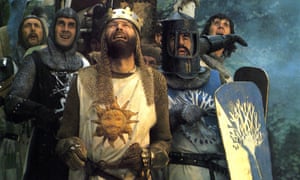
The team in Monty Python and the Holy Grail, which Jones co-directed with Terry Gilliam. Photograph: Allstar
“People with FTD end up in prison in this way. It is made worse because people with FTD have no insight into their condition. They are not aware that things are going wrong for them.”
This lack of insight can have profound consequences, Fox added. “The head of a company in the early stages of FTD has no idea that his insight has been compromised and can make decisions that have enormous consequences. There are companies that have lost all their money this way.”
A tendency to impulsive action is also noticeable. “Food can be a particular problem,” said Sally. “As soon as it is put down in front of him he will grab it and eat it. We made him a birthday cake a few weeks ago. He started to eat it before we could get him to blow out the candles.”
And then there are other people’s perceptions of his condition, which can also cause distress. “Friends often ask: will he recognise me?,” added Sally.
“I tell them: of course he will. It is his speech that has gone. In fact, he loves seeing friends. His only problem is that he no longer has the ability to tell them how pleased he is to see them.”
It is a point endorsed by Palin. “I think that must be the most difficult thing – not to be able to say quite simply how you are feeling on a given occasion. We assume that he is happy, but that assumption could be wrong. We just don’t know.”
Certainly, it is hard to believe that Jones is unaware of his condition. However, he is clearly consoled by the support of his family, who help to keep his life enriched.
It is also obvious he gets strength from the presence of Palin. Towards the end of our interview, Jones reaches out to grasp his hand, giving it a good squeeze. The pair hold hands for a couple of minutes, a gesture that perfectly reflects their 50 years of friendship – and its importance in sustaining Jones through his tribulations.
Where to find help
• The FTD support group provides practical help and information for people with the disorder and their families. Their website gives details of meetings in different regions of the UK – an important way to meet others coping with similar problems that may seem very different from those experienced in more common dementias.
• A specialist progressive aphasia support group offers help for those whose speech and language are affected.
• Jargon-free research updates can be found at www.ftdtalk.org
• The dementia research centre at UCL has a specialist focus on young-onset dementias and is linked to the cognitive disorders service at the National Hospital for Neurology and Neurosurgery, which receives NHS referrals for people with FTD.
• Join Dementia Research enables people both with and without dementia to register an interest in taking part in research.
The UK government is to fund high-tech call-blocking devices to protect dementia sufferers and vulnerable people from nuisance phone calls, although only around 1,500 people will be given the gadgets under the initial funding.
The £500,000 project will install trueCall devices in the homes of elderly and vulnerable people identified by doctors. The machines block all recorded messages, silent calls and calls from numbers not pre-identified by the homeowner, which the government says will offer particular protection for dementia sufferers.
Around £300,000 of the budget will be spent on the devices themselves, with the remaining funds allocated to management of the service and raising public awareness of scam calls.
Ministers have been pressed by health and consumer campaigners to do more about nuisance calls. One firm alone has been fined £350,000 for making more than 46m automated calls.
Announcing the fund, prime minister Theresa May said: “We want to create a fairer society by cracking down on unscrupulous practices which target the most vulnerable. This new, targeted scheme is the latest step in the government’s fight against nuisance calls, protecting those who are most at risk, including those with dementia.
“We have seen people tricked out of thousands of pounds by scam callers and this government is determined to clamp down on their activities once and for all.”
A trial of the devices last year by the National Trading Standards scams team resulted in 93% of participants feeling safer in their homes, the government said, including one person who had previously paid £150,000 to a scam caller.
Hilda Hayo, chief executive of Dementia UK, said the funding was a step in the right direction. “These calls can not only have a negative financial impact but can also lead to psychological affects such as anxiety, depression and a loss of self-esteem,” she said.
“We frequently receive calls to our national helpline from family members who are concerned that their relative with dementia has fallen prey to rogue traders.”
Further plans are being drawn up to combat the wider problem of nuisance calls, the government said, including a plan to issue fines of up to £1m if companies are found to be in breach of privacy and electronic communications regulations.
Harvey’s reaction to his dementia is not what you might expect. “I’m so happy,” he says. “I wouldn’t reverse it for anything.”
Harvey has a relatively rare dementia called posterior cortical atrophy or PCA, a variant of Alzheimer’s disease. Inasmuch as he has difficulty remembering things and can’t do basic arithmetic, his condition conforms to the stereotype of dementia. But PCA particularly affects spatial awareness: it can lead to disorientation, visual illusions, and problems with making your movements coincide with your perception of space. Harvey has trouble with vests; another person with PCA recounts how, aiming to sit in an empty seat, he found himself instead in his vicar’s lap. But for Harvey, who is 78, these are just inconveniences in a wonderful life. He has never, he says, felt so full of love for his wife, Diana, who confirms that his expressions of affection are much more frequent now than before his PCA developed.
Harvey and Diana might be considered the lucky ones. Plenty of people with PCA, and their families and carers, have grimmer stories to tell. But there are many cases that challenge the widespread perception of dementia as a condition to be dreaded. The stereotype of an elderly loved one sitting blankly in a care home, unable to speak or recognise relatives, is not all there is to it. And changing this public perception of dementia is one of the prime objectives of a £1m, two-year project called Created Out of Mind .
Music for Life 360 uses machine learning to analyse interactions between musicians and people with dementia
Supported by the Wellcome Trust and housed in its Hub space at the top of the Wellcome Collection on Euston Road in London, Created Out of Mind is the brainchild of Sebastian Crutch, a neuropsychologist in the Dementia Research Centre of University College London. As well as challenging stereotypes about what it means to live with dementia, the project aims to develop better tools for assessing the value of using arts with people who have these conditions. All too often, such efforts are perceived as “giving them something to do”, or perhaps as utilitarian therapies for sustaining cognitive skills. But if the real personal enrichment of the arts often comes “in the moment”, why should it be any different for people with dementia? And such activities can reveal a creativity obscured by impairment of an individual’s resources for regular communication.
When Crutch asked me to join the research team, I gladly accepted the opportunity to learn more about a condition that will affect most of us in our lifetime – if not as a patient then as a carer or relative. My own experience of having to gently assure my grandmother that she was still living in the house she had occupied since before I was born, and not in some unfamiliar care home where all her knick-knacks had been arranged in a simulacrum of her house, is representative of experiences most of us have had, or will have.
Alzheimer’s disease is the most familiar form of dementia, but it accounts for only about one case in three, and itself has many variants with specific symptoms. There is a galaxy of other dementias, generally diagnosed from their cognitive symptoms and perhaps brain scanning. Other neurodegenerative conditions such as Parkinson’s disease can also progress to dementia. And not all forms of dementia happen in old age – some can appear in people still in their 30s.
Neither are they all about loss of memory. It may be precisely because we are used to the experience of forgetting things like names or where we left our keys that we read the appearance of dementia as forgetfulness. But sometimes the mental disruptions that look superficially like memory loss are actually operating in a more puzzling way. Asked if she can recognise photos of famous faces – Tony Blair, Bill Clinton, Terry Wogan – one person with PCA in a video Crutch shows me can name none of them. But it’s not so much that she doesn’t recognise the face; she struggles to see it as a face. “That’s the face there, isn’t it?” she asks hesitantly as she looks at Wogan.
It’s not a lack of recognition – the patient could say perfectly well who Blair or Wogan is. Her situation seems to be akin to that experience of seeing an image or an object, perhaps when we’re tired, and being momentarily unable to decode its content: is that a face, or the folds in an item of clothing? We can see clearly enough but can’t parse the shapes and shadows. “For a person with PCA, much of the world is of that ilk,” says Crutch.
What’s lost here are not facts, but ways to interpret the world. Some forms of dementia can affect how we label concepts, or our ability to retrieve those linguistic tags. Crutch shows me clinical videos of two people with primary progressive aphasia (PPA), which affects such aspects of semantic processing. One man speaks haltingly, slurring his words, sometimes getting the syllables wrong. The sentences are perfectly coherent but are produced with great difficulty. There’s no impediment to the way his mouth moves, but he’s struggling to connect words to the appropriate sounds. This man, says Crutch, carried a card he could show to explain why he was articulating in this way – otherwise people might think he was drunk.
Sebastian Crutch, a neuropsychologist in the Dementia Research Centre of University College London.
The other PPA patient has degeneration a little farther back in the part of the brain where language is processed (the temporal lobes), impairing not word production but access to its semantic content. He is almost hyperfluent, articulating his words accurately and rapidly. The trouble is, he has lost the labels. He explains that he has been tying back his roses, but can’t describe them generically as plants, nor mention concepts like stem and thorn. Instead, with unselfconscious improvisation, he explains with finger gestures that they are things that branch and then branch again, and have those things on them that might puncture holes in your hands. “I can’t remember what you call them now, but we’ve got a thing that comes up, and they’re like that, and they’ve got all little bits on it…”
In such cases, less common words vanish sooner than ones used more often. Testing patients with animal recognition, “iguana” disappears before “dog”. Eventually this leads to extreme category errors: a less familiar image of, say, a gorilla might be interpreted, tentatively, as a car, not because that’s what it “looks like” to the patient but because he has so few categories of any sort to call upon in making an interpretation. This might tell us something about how we encode concepts mentally: perhaps we simply do more of that for familiar ones, so that we still retain some reference points when others are lost.
These are confusions in the brain’s ability to represent the world semantically. By contrast, in conditions like PCA, lesions in a different part of the brain can disrupt the “how?” or “where?” – the sense of space. One patient, asked to grasp the doctor’s right hand, does so easily. But he can’t make out where the left hand is at all, even though it is held just as clearly in front of him. After some guidance, he spots it – but asked then to take hold of it, he misses entirely and grasps the doctor’s shoulder. These spatial tasks are processed by both sides of the brain, each side dealing with the opposite region of space. So the lesions in this patient are probably concentrated on the left-hand side.
It’s hard for us to imagine this – it’s not at all like having only one eye working. “Everyone thinks vision means eyesight – they don’t connect vision problems with dementia,” says Crutch. But most people with Alzheimer’s will experience visual impairment at some stage, he says.
Harvey, a former electronics engineer who played drums and piano in a jazz band for much of his life, has his own experience of such spatial distortions. He was playing the piano when suddenly the keyboard seemed to have risen by four inches. Another time the keys seemed to disappear. As it is, he can no longer remember what the notes are called, nor can he decode written music (“all those lines!”). But like many jazz musicians, he plays primarily by ear, and still practises for several hours a day. In that still poorly understood miracle of the musical mind, he finds his fingers can keep going when his conscious mind cannot, constructing complex jazz chords that surprise him.
The visual illusions of PCA can be deeply disconcerting. Helen, a woman caring for her mother now in an advanced stage of the condition, tells me that her mother would furiously accuse her husband and other relatives of playing tricks on her when the coffee jar suddenly “reappeared” from where it had vanished a moment ago. This kind of irritable response, while wearing for carers, is a natural strategy for rationalising the confusion. Objects don’t disappear without a “reason”! Helen says her mother went through umpteen pairs of glasses, apparently a typical experience in the early stages of PCA.
Object Decision, by the artist Charlie Harrison, 2014, is a series of paintings based on tests used by neuropsychologists to determine how well someone is processing visual information. These tests are used in the diagnosis of posterior cortical atrophy (PCA).Asking the public to try to identify the silhouettes has been a good way to get them involved in a conversation about neuropsychology and people affected by dementia-related visual perception. Photograph: Charlie Harrison/Wellcome Collection
At the beginning, the visual distortions can come and go, often prompting frustration or disbelief from others. Helen explains that her mother would occasionally lose the ability to navigate drinking from a cup – but at other times it was fine. “Even her best friends didn’t believe her,” she says.
Care home workers can’t possibly know all the nuances of dementias, and are generally used to working with people showing the gradual, predictable decline in abilities that comes with Alzheimer’s. It’s understandable, then, that they might not appreciate that because a patient like Helen’s mother has just taken a sip of tea, she might not be able to do so in five minutes’ time. It’s not hard to see how this could lead to suspicions of “playing up”, especially when patients are themselves made grumpy by the difficulties.
Perhaps most disconcerting of all are visual hallucinations of the sort that can be produced by the relatively common condition called “dementia with Lewy bodies” (DLB), which sometimes occurs alongside Alzheimer’s. One person in Seb’s videos talks clearly and calmly about finding his house full of people dashing about.
“I came home one night, and all of a sudden there were people in the room,” he says. “There must have been at least a dozen, running and screaming everywhere. When you see that, you panic yourself – you don’t expect anyone in your own living room. One was dressed like Coco the clown. I thought I was dreaming.”
Seeing people is quite common with DLB, but other hallucinations can be more surreal. One person diagnosed with the condition told Crutch that when he looked at table edges and door frames, he saw them bending. But his rational brain knew that this couldn’t be true.
There’s the problem: it’s not so much that you’re seeing things that aren’t there, but that our brains, still retaining the power of reasoning, have to deal with impossible information. “How do you hold that tension between the two things without driving yourself mad?” Crutch asks. And who can we trust, if we can’t rely on our own senses? Even the man who saw Coco the clown in his living room admitted scepticism about being told he was just hallucinating. How can we go on and on dismissing what we’ve seen if it doesn’t seem to fit with what we know ought to be so?
Seen this way, says Crutch, responses from some dementia patients that might be interpreted as aggressive, paranoid or obnoxious might in some respects be perfectly normal reactions to an unfaithful mind – all the more so when the condition has developed beyond the point of a patient’s conscious ability to rationalise away their hallucinations. If your handbag is “not where you left it”, isn’t it reasonable to conclude that the care home staff have stolen it?
A particularly distressing form of the confusion that DLB can induce is called Capgras syndrome. Here the patient recognizes a carer or family member but loses the ability to connect that individual to the one they remember. They become convinced that he or she has been replaced by an impostor.
One woman described her husband’s experience of this condition. “He said, who are you and what are your duties here? So I said, Well, I’m Betty. And he said, Yes, but you’re not the Betty I know. I said, There’s only me. That’s when he started walking up and down the stairs, going in and out of the rooms, wouldn’t sleep.”
It seems such a bizarre belief that the invitation is to imagine the person has totally “lost their marbles”. But on the contrary, says Crutch, the “impostor” interpretation is also a reasonable deduction. “If it doesn’t feel like the person you know, then you’re not being irrational, you’re trying to use the rationality available to you to explain the experience.”
Dementia is mostly, and rightly, associated with deficits of one kind or another in mental abilities. But the mind is extraordinarily inventive about circumventing difficulties or improvising with what it has to hand, and it’s not so surprising then that these neural gymnastics might introduce new aspects of personality, new interests and capacities. These might be puzzling or bewildering to people who see a loved one change, but as Harvey attests, the results need not be solely negative. Someone might develop a hitherto unseen passion for opera. They might take up painting with almost manic energy. Or they might discover new facets of their creativity.
In the case of British artist William Utermohlen, who was diagnosed with Alzheimer’s in 1995, painting enabled him to create an extraordinarily expressive testament to his disintegrating sense of self. Utermohlen’s self-portraits, produced over the following five years, have been widely hailed as offering an insight into the condition. The final portrait, painted in 2000, seven years before his death, is a pencil-drawn head with two black holes for eyes, suggestive of a soft toy long neglected in the dust of a playroom.
But what remains intact in all these images is a sense of artistic integrity – their increasing abstraction sacrifices nothing of the power. Crutch visited Utermohlen in his flat in late 1999, when he still retained some ability to communicate. He was able to indicate how one striking self-portrait at his desk under a skylight, with one hand clinging to the corner, reflected his sense of desperately trying to hang on and avoid being swept out of the open window. “I suspect that the painting was more eloquent than anything he could have said at the time he painted it,” says Crutch.
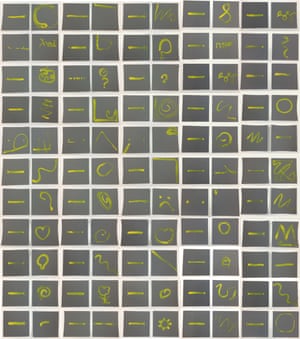
To test the effect of dementias on the way people express themselves through gestures, a Created Out of Mind research project asked participants to paint a line on a pair of canvases: on the first, the straightest line possible, by joining the dots; on the second, an expressive line of their choice. Between the start and end point of the gesture, data is gathered and analysed (heart-rate, eye-tracking, temporal experience etc). Photograph: Charles Harrison
Some see this as no different from the artist’s usual practice of conscious self-expression, albeit with diminishing resources. But Crutch is convinced that not everything in such art might be there by intention; the works might also testify to the nature of the condition. When Utermohlen was in their research centre at UCL, they asked him to draw a man. Far from the stick figure most of us would have produced, Utermohlen produced a beautiful sketch full of charm and wit. But there was something amiss. He knew it, but couldn’t figure out what it was.
To Crutch, and to most of us, it couldn’t be more plain: both of the figure’s arms were coming out of the same shoulder socket. This was a classic example of the spatial confusion of PCA. “I absolutely deny that this was his artistic intent,” says Crutch. “His tools had just been blunted.”
As well as seeking to change public perceptions of dementia, Created Out of Mind hopes to explore the role of the arts in these conditions. In projects such as Music for Life 360, which uses machine learning to analyse interactions between musicians and people with dementia, and a study of psychological and hormonal responses of a choral group, researchers will be seeking new ways to measure the effects of engaging in artistic activities.
Very often, initiatives such as this are seen solely therapeutically: as “good for the patient”. There’s no doubt this can be true, but as Utermohlen showed, they have far greater potential. Because arts may involve different parts of the brain – different communicative pathways – from the faculties of daily interaction such as talking, they might help to keep channels open. It’s very common for patients who might have become nonverbal to respond to music, perhaps even to sing.
The temptation is to respond that “At least she remembers something!” But there could be more to it than that. As conditions like PPA show, loss of language use doesn’t necessarily imply loss of understanding or desire to interact verbally. In fact, the extreme deterioration of that ability can produce some incredibly poignant testimonies to the inventiveness and determination of people to communicate. One man with PPA was, in the late stages of his condition, left with only two words: “Millionaire” and “Bub”. But, says Crutch, he would manage with just those severely depleted resources to express feelings and responses with the tone of his voice.
So arts aren’t just a “way of keeping them occupied”, but may become avenues for releasing genuine creativity. It’s easy to assume with people rendered mute by dementia that their understanding and inner life has gone just as silent. “You hear time and time again from carers who use music with patients that suddenly there’s a reconnection,” says Crutch. They often say not that this has transformed the patient but that it confirms that the awareness they always thought was there really is there.
Susanna Howard, founder of the charity Living Words, works with people with dementia to produce poetry (see panel). The remarkable, often moving results show the form’s capacity to express the person’s experience:
We lost a lot of nice things, all kinds – They go away. A little bit I got here and then All of a sudden there was nothing I could tell you. Could not put two together. I had a lovely story But it took my – you know, when I found out I couldn’t talk mouth ways, like now, I can’t think.
These points of connection are reminders for us, the healthy ones, that the person with dementia, who doesn’t know who we are any more and can’t talk and doesn’t even seem to see us, is still a person.
“Because we focus so much on the verbal, there’s an underlying lack of clarity about what these people actually experience when they can’t tell us any more,” says Crutch.
Lacking their direct testimony, we’re apt to make assumptions about it – which might obscure the person now for what we imagine them to have once been. This engagement with the present is precisely what the arts can offer, says Julian West, an oboist and researcher at the Royal Academy of Music. West has for years made music with people affected by dementia, for example in the Music for Life project at London’s Wigmore Hall.
“A few years ago I was working with a woman who was a Holocaust survivor,” he tells me. “She had very little capacity for verbal communication, and there was a lot of anxiety surrounding her, with carers worrying about how her dementia might ‘unleash’ memories of her experiences. The ‘in the moment’ experience, however, was that she looked at everyone with bright, animated eyes, and was very engaged with the music-making. At a pause, she made eye contact with me and very playfully sang ‘cuckoo’. I and the other two musicians were able to then improvise a piece with her based on her cuckoo motif, which she continued to sing. It was an expression of her playfulness and energy, and let us relate to her as she wanted to be rather than through our worries about her.”
West continues: “The focus of the work I am involved with is not at all about ‘helping people to remember’. I sometimes wonder whether the perceived need for people with dementia to remember things is more important for family, friends and carers. The idea that someone can retain value and identity independent of memory and capacity is outside many people’s thinking, and so the loss of memory is very frightening for them.
“The arts are a powerful vehicle for helping everybody to understand more of the complexity and diversity of people’s experiences,” says Crutch,”and to adjust ourselves to better maintain our social contact. Again and again we come across people who say: what really helped us to understand this person was connecting through music, or sharing in a response to a picture, or a carer seeing someone who can still create something. It can still be about who they are, not just who they were.”
Words unlocked: dementia and poetry
Making poetry with people with dementia takes time, explains Susanna Howard, artistic director of the project Living Words. She typically spends several months in a care home, generally with people with advanced dementia – beyond the point of reminiscence. “We don’t ask any questions,” she says. “We sit in silence in the shared experience with the participant, and as words come we write them down and read them back to the person.
“All words matter. It can be the smallest, seemingly insignificant words a person uses that have the most meaning for them, and we write every word down without trying to ‘make sense’ of them. ‘I don’t know’ or ‘Nothing’ says a lot about how that person is feeling.”
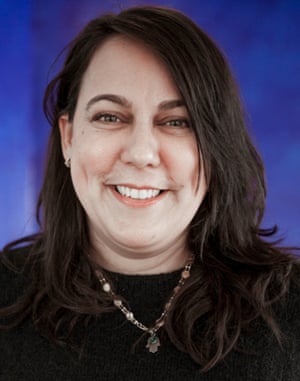
Susanna Howard
One person she worked with recently kept repeating under her breath, “I am the woman no one is watching.”
Then the editing begins. “We slowly start stripping away, reading their words back and seeing whether they resonate with the person. We only remove – we never add or jiggle words and meaning around. The intention is that the pieces are being written for that person, for them to feel validated. Often you can be reading a person’s words to them and they say ‘Yes, that’s just how I feel.’” The titles of these pieces are usually the first response that the person has on hearing their words read to them: Want People To Know What It’s Like, Can’t Think, I’m An Okay, All You Got.
This is deep work, Howard says. “We have the luxury of time to sit with people one-to-one. And it’s about equality of relationship within the creative process – the person is not ‘having art done to them’ but is actively engaged in meaningful shared experience.”
There can be direct therapeutic benefits. “This is like medicine to me,” said one care home resident. It offers social interaction and can encourage better relationships with caregivers, and allows people to feel heard and validated.
The results, however, reach beyond the personal. Like the best poetry, what they offer is a direct, stripped-down truth: a communication where, perhaps, none seemed any longer possible.
Speaking
This place is mad, it is I think, think it’s good To get out, I’m speaking Look at round there They’re wanting me now A mad one, near Don’t say much It will come The lost word
A TV campaign that shows Santa forgetting Christmas after developing dementia has been cleared by the ad watchdog following complaints it was offensive and could distress children.
The festive campaign, called Santa Forgot, was run by the charity Alzheimer’s Research UK to raise awareness of dementia and help boost donations.
The two-minute clip, narrated by Stephen Fry and animated by Aardman, the studio behind Wallace and Gromit, tells the story of a girl called Freya who asks her father about Santa, who no longer delivers presents because he has dementia.
In the ad the girl goes to the North Pole to save Father Christmas, offering support and encouraging his redundant elves to become researchers to find a way to cure the disease.
Three dozen viewers contacted the Advertising Standards Authority to complain that showing Santa having Alzheimer’s disease was offensive, could cause distress to children and questioned whether it should have been allowed to run when young viewers might see it.
Tim Parry, a director at Alzheimer’s Research UK, said the ad targeted adults and carried an “ex-kids” scheduling restriction, meaning it did not air in programmes when young children were likely to be watching.
It was only broadcast once before 7.30pm in an episode of Emmerdale on ITV because it involved a serious dementia storyline involving a main character.
Parry defended the use of such a hard-hitting strategy to get the charity’s message across to viewers.
“Our aim was to raise awareness that the diseases that cause dementia strike indiscriminately,” he said. “If we are to fight the misconceptions about dementia that still persist in society, we have to challenge them head-on.”
In its ruling, the ASA admitted that the ad might upset some viewers, with the depiction of Santa potentially likely to “cause discomfort to some younger children”.
However, the ad watchdog said the issue of dementia had been handled “sensitively” and the sad story of Santa was told in a “gentle, non-graphic way with a generally positive ending”.
The ASA’s investigation found the campaign did not breach the UK advertising code relating to harm and offence, children and scheduling.
The use of shock advertising is a common tactic used by charities to promote their cause and galvanise an often apathetic public into donating money.
A spokesman for the ASA said that the watchdog had traditionally granted more leeway to public service and charity ads in relation to UK ad code rules because of the importance of the issues about which they are trying to raise awareness.
In 2015, the ASA received 1,752 complaints about 799 ads from what it terms the “non-commercial” sector, which includes charity advertising. This is from a total of 30,000 complaints about 20,000 ads in 2015.
The ASA has previously investigated whether it was too lenient in letting charity and public service advertisers get away with shock tactics.
It moved to examine its policy after participants in a survey it conducted complained that some ads went too far with deliberately distressing content to make people feel upset or guilty, particularly those targeting children’s TV channels.
The ad watchdog’s investigation into its policy concluded that it was not being overly lenient, but it did introduce more thorough checks of charity and public service ads that receive complaints.
Years of heading balls and colliding with other players could be damaging footballers’ brains and putting players at risk of developing dementia, scientists have suggested.
The claim comes from the researchers behind a small study which examined the brains of six footballers who developed dementia after long careers in the sport.
Postmortems found that all six had Alzheimer’s disease, while four also showed evidence of chronic traumatic encephalopathy (CTE) – a degenerative disease linked to repeated blows to the head. Both CTE and Alzheimer’s disease are linked to the build up of clumps of particular proteins in the brain – although the location of these proteins is crucial in diagnosing CTE, which can only be done after death.
“Our findings suggest that there is a potential link between repetitive sub-concussive head impacts from playing football and the development of CTE,” said Helen Ling, a co-author of the study from Queen Square Brain Bank for Neurological Studies at the University College London Institute of Neurology.
However, others were quick to warn of the study’s limitations, pointing out that it showed no clear evidence that playing football could increase the risk of developing dementia. What’s more, neither genetic or wider aspects of the players’ lifestyle were taken into account – factors which are known to influence the risk of developing dementia.
The authors admit that it was also not clear whether the players would have gone on to develop dementia if they hadn’t spent time on the pitch.
“The most pressing question now to ask following up [on] this study would be how common dementia is among retired footballers,” said Ling. “If we can demonstrate that the risk is higher than the normal population that we will know we really need to urgently look at who is at risk and put protective strategy in place.”
The impact of blows to the head on the health of those who take part in sports has received growing attention in recent years, most notably in American football and boxing. According to research from the Boston University CTE centre, 90 of 94 former NFL players whose brains were studied tested positive for the disease, and last year the NFL officially acknowledged the link between head trauma and CTE.
In football – or soccer – the issue has received less attention, although the situation is beginning to change. In 2002 an inquest found that veteran player Jeff Astle died from “industrial disease”, ruling that the player’s dementia was the result of repeatedly heading the ball.
Published in the journal Acta Neuropathologica by a team of British researchers and funded by the Drake Foundation – an organisation dedicated to exploring the impact of concussion in sport – the new study found that the six men who underwent postmortems had a variety of other conditions present among them that would have contributed to symptoms of dementia, with all six showing signs of Alzheimer’s. All six showed tearing of the septum pellucidum, a thin membrane in the centre of the brain. “This is a feature very common in professional boxers and it’s been linked to repetitive traumatic brain injury,” said Ling.
With previous studies having shown the rate of CTE in the general elderly population to be around 12% and tearing of the septum pellucidum around 6% in the general population, the scientists say the higher prevalence in the new study could be down to impacts to the head during the men’s football careers.
The authors admit that it is not known how frequently, or with what force, blows to the head could trigger CTE. With only five of the six who underwent postmortem reported to have had concussions during their career, and then only once each, the study suggests sub-concussive blows could take their toll.
But Huw Morris, another author of the research from UCL, played down the need for concern among those who enjoy a kickabout. “I don’t think that in general terms these are findings that can be extrapolated to the general population,” he said. “These are people with very high amount of playing and exposure to whatever the head injury risks are within football.”
The team say more research, and larger studies, will be needed to unpick the issue further and welcomed research attempting to pick up signs of CTE before death.
Peter Jenkins, a neurologist and researcher in traumatic brain injury from Imperial College London, who was not involved in the study, emphasised the small scale of the research, adding that it does not tackle the issue of how common CTE is in footballers, or what sort of blows could cause it. “We need to spend more time really determining how many people get dementia who have a history of head injuries and then how we can determine what is actually attributable to the head injuries and what is just going to happen anyway,” he added.
Morris agreed that people should not hang up their boots just yet. “One of the really important risk factors for dementia is cardiovascular risk. Ex-footballers have much lower cardiovascular mortality – hypertension, heart attacks and strokes – than do the general population,” he said.
“So it remains the case that football is overall beneficial for your overall health. Ex-footballers have a lower mortality than the general population, but nevertheless we need to understand a lot more about these brain diseases, especially as we are all part of an ageing population.”
It was wonderful spending the day with Irene and sharing our passion for football by watching our rival teams – Leicester City and Chelsea – play each other. We had so many laughs together.
Fiona and Irene really hit it off when they met up, after being brought together by an online matching service. But if this sounds like the makings of a great first date, the relationship is actually far more complex than you might expect.
They were partnered up by Side by Side, an innovative matching service that we at the Alzheimer’s Society are launching today, which is designed to connect volunteers to someone with dementia.
Side by Side is a completely new approach to volunteering. From joining a local club, going to football matches or just heading out for a stroll together in the park, the app pairs up people with dementia and volunteers with shared interests. A third of people with dementia lose friends after their diagnosis, and nearly two thirds who live on their own feel lonely. We know that one of the most important things for those affected is to remain part of their community and continue to do the things they love. By taking part in activities with the support of a volunteer with similar interests, they can continue with their hobbies – or even find new ones.
My team set up the service which was particularly important to me after seeing my granddad’s experiences with dementia. As his condition deteriorated, he became increasingly confused; he didn’t know whether he had just arrived at church or was leaving it. Although he had great relationships with all the people at his local church, they had limited resources to support him. The moment he had to stop doing something he had done his whole life broke his heart. If a service like Side by Side had been available, he wouldn’t have had to stop.
Side by Side has got off to a promising start. There are almost 2,000 people with dementia waiting to be paired up and we are urgently calling for more volunteers.
What makes this volunteer programme different is the flexibility. Side by Side is designed so that almost anyone can volunteer. It is flexible, so meeting up can be easily arranged around work and family, and a telephone service is also available for those with more limited time.
I was so convinced of the merits of the scheme that I decided to put my money where my mouth is. Despite having a busy lifestyle, doing a job I love and running around after three kids, I signed up as a volunteer. My Side by Side partner, who has Alzheimer’s, shares my healthcare background and love of gardening. I’d always wanted to learn how to grow my own vegetables and now that I’ve met Maggie,I know how to do this.
Maggie isn’t just a volunteering project; she’s a friend. Her daughter told me that it was the first time she has seen her mum smile in a long time.
Kathryn Smith is director of operations at Alzheimer’s Society. More information about volunteering for Side by Side or accessing the service can be found here.
Talk to us on Twitter via @Gdnvoluntary and join our community for your free fortnightly Guardian Voluntary Sector newsletter, with analysis and opinion sent direct to you on the first and third Thursday of the month.
You don’t need to spend long in Purley to realise the town is home to many elderly people. The otherwise unremarkable suburb of Croydon is surrounded by numerous residential care homes, and in Purley Library, staff are used to adapting to the needs of elderly visitors.
While the older generation adds much to the town’s community and economy, there are occasional issues: visitors from the local care homes often forget where they are or what they are looking for. “We’ve had two already this morning,” one librarian says on a Friday afternoon in January. Another local describes how she notices some people having trouble in shops, struggling to remember pin numbers or momentarily forgetting what they are buying.
In 2012, Croydon determined that 3,300 residents of the borough are living with dementia, above the London average, and set to rise to 4,500 by 2025. So when Purley Bid, the business improvement district, held a meeting to discuss measures to improve the town, much centred on finding new ways to support the elderly population.
“We realised there wasn’t much being done for them,” says Yuliana Topazly, marketing manager for Purley Bid. “Businesses knew they needed to do more to make them feel more welcome in the town centre.” After dementia awareness-raising events hosted by the Bid last year, and a number of workshops run by the Dementia Friends initiative, Purley was designated a dementia-friendly community in January this year.
The focus is now on providing free training so locals can better recognise, understand and assist those with dementia. Dementia-friendly businesses are provided with stickers displaying the Alzheimer’s Society forget-me-nots flower logo, which are date-stamped to encourage business owners to maintain standards.
A sign in Bruges, Belgium denoting a ‘dementia-friendly’ shop. Photograph: Ross Davies
The Alzheimer’s Society has designated 220 communities in England and Wales as dementia-friendly, aiming to reduce stigma around the disorder and improve safety and quality of life for those who experience it. The charity is campaigning for London to be the world’s first “dementia-friendly capital city” by 2020, defining such a place as “a city where every person with dementia – no matter who they are or where they live – can live well and access the right support, at the right time, in the right way”.
The concept of dementia-friendly communities was born in Japan in the 1990s, where an ageing population forced radical thinking: rather than exclude people with dementia from society, Japanese cities developed a range of programmes that would allow those living with dementia to continue to engage with the world around them. It’s estimated that the condition will affect 7 million – or 20% of all people aged 65 or over – in Japan by 2025.
In the Belgian city of Bruges – a place where 2,000 of the 116,000 residents have dementia – 90 shops classify as dementia-friendly. They display a logo of a knotted red handkerchief – a symbol of the traditional memory aid – which signifies that staff can offer assistance to people with the condition. The initiative, set up by charity Foton, has also been distributing dementia guides and training sessions.
We want people with dementia to feel confident to go out
Dementia is also a growing problem in the UK. The Alzheimer’s Society believes it will affect more than 1 million residents by 2025. Of the 850,000 people who currently have dementia in the country, 40% said they feel lonely and 34% don’t feel part of their community. To counter this, in February 2015, former prime minister David Cameron introduced the challenge on dementia 2020, which called for half the population of England and Wales to be living in a recognised dementia-friendly community by 2020 and for there to be 4 million “Dementia Friends”.
“Dementia Friends are those who have had awareness training in understanding and empathy,” explains Sara Miles of the Alzheimer’s Society. “That’s a crucial element in the community – you need those working in the infrastructure to understand the needs of people with dementia in your area.”
“We want people with dementia to feel confident to go out; we don’t want them sitting at home,” adds Miles. “We want them to stay active for as long as possible, to do their own banking or shopping, so that’s where retailers are so important. We want to keep those parts of the brains active as long as possible and to retain that quality of life, so they interact rather than sitting at home feeling isolated and alone.”
There’s no single set menu of measures to employ when creating a dementia-friendly community; instead areas are encouraged to choose what works best for them. These communities tend to be built from the ground up, often having been championed by people with direct experience.
Not everyone embraces the dementia-friendly idea. One Purley resident said: ‘My dad had dementia, and I wouldn’t have wanted him going out alone without a carer, even if there had been local improvements.’ Photograph: Stefan Wermuth/Reuters
It’s then down to community groups to contact a body like the Dementia Action Alliance, an umbrella organisation consisting of 150 groups working in the field, who can offer advice. This is an intensely localised concept, created so each community is able to adapt to specific needs.
“There are certain strands that come up regularly – arts, businesses and shops, transport, community associations, housing – but a community can decide what they want to focus on and what tools to use,” Miles says.
In the London borough of Lewisham, for instance, there has been a drive to persuade museums and arts venues to offer dementia-friendly activities, as well as working with shops, supermarkets and banks to provide slow lanes and special assistance. In York, a taxi firm has introduced a dementia-friendly service. In Bradford, particular effort has gone into working with a local primary school and also with gurdwaras to break down barriers in the Sikh community.
Raising awareness of the scheme is a challenge. Speaking to locals in shops and cafes in Purley, there seems to be little knowledge about its new status, although most like the idea. Anura Kalubowila, who runs the Purley View residential care home, understands the value of a supportive external community for those with dementia. “We would be happy for residents to get out more,” he says. “We do excursions with them already – stimulation is important.”
Lynda Pennington, a manager at the Purley Cross community centre, is pleased about the training on offer. “We want to upscale our volunteers to be dementia friendly,” she says.
“We often get people in here with dementia and it can be difficult, but as a community we are aware of the needs of old people because of all the local care homes. With training people can be even more responsive. Shopkeepers should come to get the training, it’s in their interests as it benefits the community.”
Training can help retailers interact better with people with dementia. Photograph: Rex Features
The only dissenting voice came in a nearby cafe. “My dad had dementia, and I wouldn’t have wanted him going out alone without a carer, even if there had been local improvements,” says a manager, who preferred to remain anonymous.
Purley Bid aims to challenge such fears and hopes that over time, people with dementia will feel more welcome and safe in the community when they leave their homes. Topazly hopes people may choose to move to Purley precisely because it has dementia-friendly status.
Issues around ageing are increasingly important to cities. While dementia-friendly communities share some characteristics with the broader concept of age-friendly cities, there are crucial differences. Natalie Turner, who works for the Centre for Ageing Better, has studied how the two approaches work in the US.
“Age-friendly is much broader and deeper, looking at how to tackle the challenge of demographic change,” she says. “It’s much more holistic, focusing less on decline and disability and more on change and opportunity.
“Dementia friendly is a much more specific lens, it’s grassroots and very localised, usually focused around a high street. It’s also more focused on training – getting people to understand needs. It’s not really going to be embedded into the city planning. As a result, the age-friendly conversation can inadvertently neglect the needs of the most vulnerable, and people with dementia and their carers can get left out of any big planning.”
One body working with this problem is the University of Stirling’s Dementia Services Development Centre. They use design to improve the private and public realm by encouraging dementia-friendly measures that promote familiarity, legibility, distinctiveness, accessibility, comfort and safety. “It’s about making sure surfaces between floors and walls are clearer, making exits and entrances much more obvious,” says Turner.
For such major changes to be introduced, the conversation about dementia friendliness has to go beyond communities and into local councils. This is partly why Purley Bid has begun talking to Croydon council about the plans.
“We need the council to put the resources out there so people have the information they need,” says Topazly. “Maybe any new business that opens on a high street should be encouraged to think about customers who have dementia. We want Croydon to be leading on this. The needs of the population are changing and there needs to be a close partnership between residents, business community and the local council. If everybody does their small bit from each corner it will have a much bigger impact.”
Follow Guardian Cities on Twitter and Facebook to join the discussion, and explore our archive here