challenging etiketine sahip kayıtlar gösteriliyor. Tüm kayıtları göster

7 Mart 2017 Salı

Medical couriers launch case challenging self-employed status

Couriers carrying emergency blood supplies to hospitals and samples to laboratories are to challenge their self-employed status in the first gig-economy test case to hit the healthcare sector.


The five cyclists, motorcyclists and van drivers, who all work for The Doctors Laboratory, a company which provides pathology services to the NHS, argue that they are employees and not independent contractors.


“I risked my life every day to get emergency blood to people, but the company won’t even recognise my basic employee rights without a fight,” one claimant, Ronnie De Andrade, said.


“I have been working for them for over five years and I don’t see my life progressing like this. I can’t get a mortgage, I have no pay when I go on holiday and I can’t get sick because I won’t get paid.”


TDL said it had not received formal notification of any employment tribunal claims brought by any of its couriers.


“We keep the working arrangements of our couriers under constant review to ensure that we comply with the latest standards and legal requirements,” a spokesperson said.


The couriers’ claim for employee status, which was filed on Tuesday at the London central employment tribunal, goes a step further than previous gig-economy cases – against taxi hailing app Uber and courier firm City Sprint – which both successfully argued drivers were officially “workers”.


Workers, who are employed under a contract in which they must always turn up for work even if they don’t want to, are entitled to employment rights including the national living wage, holiday pay and protection against discrimination, and may also miss out on other benefits including sick pay and maternity leave.


Employees have those additional rights guaranteed as well as protection against unfair dismissal, statutory redundancy pay and the right to request flexible working.


A self-employed person receives no entitlement to employment rights, beyond basic health and safety and anti-discrimination framework.


Jason Moyer-Lee, general secretary of the Independent Workers’ Union of Great Britain, said the TDL case was a “black and white example of bogus employment status”, as the couriers were required to work regular shifts dictated by the company, had to request time off and were not allowed to reject deliveries they were told to do. They are also not allowed to take outside employment while working for TDL.


The case has emerged as employment experts call on the government to tackle exploitation of the lower paid by abolishing different categories of worker after a string of scandals concerning the treatment of lower paid workers in the UK. The chancellor Philip Hammond is also expected to announce a consultation on the taxation of the self employed in Wednesday’s budget.


Speaking on Tuesday at the first hearing into the future world of work by the Commons business, energy and industrial strategy committee,


Hannah Reed, a senior policy officer at the Trades Union Congress, said: “There should be a floor of rights for all working people – a single worker definition.” Sue Tumblety, founder and managing director of the employment human resources consultancy HR Dept Ltd, added: “I would like the ‘worker’ category to go.”


Moyer-Lee said there was clarity between the different classes of worker but there needed to be better enforcement of the rules. He said: “I’m not in favour of eliminating worker status. I think there are are people who are in between an independent contractor and an employee.”


He added that getting rid of worker status might also make it harder for those currently classed as self-employed to win more rights from their employers – because the hurdle of proof was higher.


Medical couriers launch case challenging self-employed status

24 Ekim 2016 Pazartesi

Generation of hope: the girls challenging misogyny in the heart of rural Paraguay

At the end of a 20km red dirt track winding through a rainforest in eastern Paraguay, lies a secondary school for girls providing a source of hope in a country that has a notorious reputation when it comes to women’s rights.


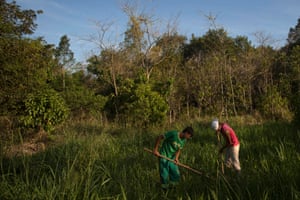
“Machismo is very strong here,” says Palmira Mereles, as she scrapes the dirt from a freshly unearthed root vegetable, a manioc, in the school’s garden. “Only men have a voice. Women aren’t encouraged to have dreams or opinions.”


Now 21, Mereles was part of the first year group to study at the Mbaracayú Education Center when it opened in 2009. Built by the NGO Fundación Paraguaya, it aims to tackle precisely the problems she points to: the issues of gender equality in this small landlocked country.


It has been a year since Paraguay’s strict abortion laws were brought to international attention when a 10-year-old girl was denied a termination. The girl, known as “Mainumby”, was allegedly raped by her stepfather, but abortion in the predominantly Catholic country is only legal if the mother’s life is at risk. Amnesty International describes these laws as “draconian”, and despite repeated requests from the girl’s mother, protests within the country and across the world, the authorities refused to allow it.


We were treated like a house of witches


Gloria Rubín


This was not an isolated incident. Teen pregnancy rates are among the highest in the region. More than one in 20 girls under 20 have given birth (pdf); and in rural areas, like the Atlantic forest, a quarter of these girls are aged 14 or under. As a result, many are unable to finish their education.


“Gender discrimination is common across Paraguay,” says Celsa Acosta, the school’s founding director. “Poverty is desperate, particularly in rural areas, and girls suffer the worst consequences. We wanted to help them take control of their own lives.”


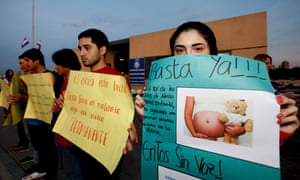
A woman holds a sign that reads “Stop now” during a protest against child sexual abuse, Paraguay


Protests against child sexual abuse erupted in Asuncion, Paraguay’s capital, after the Mainumby case. Photograph: Cesar Olmedo/AP

Activists have often come up against the country’s traditional Catholic background. Gloria Rubín who was Paraguay’s minister for women when the school was built, produced a sex education handbook to be distributed to Paraguayan secondary schools. But the church organised protests against it, and the book was withdrawn. When she later travelled around teaching the handbook directly to teachers across Paraguay, the church pursued her with demonstrations, she says. “We were treated like a house of witches.”


[Sex education] is taught from the perspective of the Catholic ​church, which means it’s stuck in the 19th century


Gloria Rubín


The school sits in an isolated clearing surrounded by the Mbaracayú reserve, which protects the largest surviving fragment of Atlantic forest in Paraguay (only 7% of the original forest remains). The small campus is scattered with dormitories, classrooms and thickets of lofty palms. Alongside the vegetable garden where they grow potatoes, maize, courgettes and peanuts, there’s a livestock farm, hotel rooms, and a tourist trail winding into the undergrowth.


In this richly fertile yet vulnerable area, the school aims to grow these girls into leaders of sustainable development in their communities. They are taught techniques for agribusinesses and IT skills, which is particularly unique for indigenous communities. Alongside the national curriculum, they can also study a range of vocations, including textiles, tourism and environmental management. More radically, they provide programmes on gender, self-esteem, and sex education.


Sex education across the country is “inadequate” according to Rubín. “It’s taught from the perspective of the Catholic church, which means it’s stuck in the 19th century,” she says. Yet it has a central role at the Mbaracayú school. Girls are taught about their sexual and reproductive rights on a weekly basis, in what the school describes as “orientation” classes focusing on their physical and psychological health.


Working on a reforestation project in the Atlantic forest


The Atlantic forest is home to the only living examples of almost 10,000 species of plant. Photograph: Felipe Dana/AP

“I became pregnant very young, because I lacked the information to know any better,” school founder Acosta explains. “It really marked me as a person. I decided then to make sure girls of the next generation have access to the information that I never did.


“We teach about contraception and ensure girls understand their own fertility,” she continues. “But just as important, in a macho culture, is cultivating their self-esteem. They need to know what they want and be able to assert it in their relationships.”


The school also gives a second chance to girls who previously dropped out of education. Elva Gomez, 19, lives and studies here with her four-year-old daughter.


“Before coming here, I thought I’d just stay at home and look after Romina,” she says. “But now I want to finish my studies and train to be a nurse.”


The Mbaracayú school hopes that girls will be able to better support themselves and their families with the qualifications and skills they offer. Students from indigenous communities study for free, while most Paraguayan families pay 100,000 guaraní a month (£12). And though many parents of local indigenous communities were initially sceptical about this progressive school, most are now keen for their daughters to study there after witnessing its benefits – two graduates of the 2011 class are now primary school teachers in their communities.


Students are also encouraged to apply for university scholarships, both within the country and abroad. Mereles studied agricultural sciences in Costa Rica, before returning to teach and run the vegetable garden.


“I’ve known many girls who didn’t want to continue studying,” she says. “They didn’t believe they could achieve anything. But over time their attitudes change. They become much more confident.”


With the school’s drop out rate at just 9% compared to 17% throughout the region, there is a new generation of girls from the heart of the Mbaracayú forest who are gaining the confidence to fight for their rights – and the potential for change in the rest of the country is perhaps within reach.


Join our community of development professionals and humanitarians. Follow @GuardianGDP on Twitter. Follow the conversation on the hashtag #LatAmNow.


Generation of hope: the girls challenging misogyny in the heart of rural Paraguay

28 Haziran 2014 Cumartesi

The NHS is at breaking level challenging perform and commitment alone won"t conserve it

Health - NHS Hospital ward reception

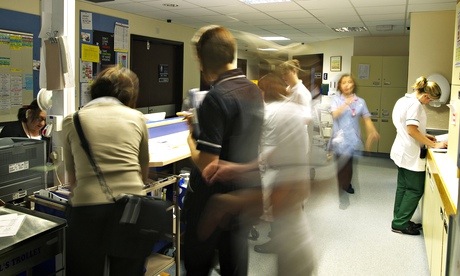
A occupied ward reception area in an NHS general hospital. Photograph: Pulse Picture Library/PA


The NHS has coped properly at a time of unprecedented monetary stress thanks to the hard function of one.three million staff across England. Physicians, nurses, therapists, managers and numerous others have ensured that most individuals most of the time acquire higher-good quality care without obtaining to wait longer than needed. They have also squeezed far more worth out of each and every offered pound to enhance care and stay within budget.


But speaking to these workers virtually each day, as I do in my occupation, I hear men and women wonder out loud how a lot longer they can proceed to work at this degree of intensity to safeguard and protect the service they know and adore.


More hospitals are in deficit or expecting to be so. Other people are struggling to hit waiting time targets and provide timely and practical appointments. Psychological overall health providers, community companies and GPs are also all affected. There is often scope to enhance efficiency in public solutions and the NHS is no exception. Smarter procurement of items and solutions, better use of staff to reduce the fees of high-priced company and locum workers, and greater coordination of care could all support the £100bn yearly well being budget go even more. Jeremy Hunt is also correct to argue that lowering errors and strengthening patient security will totally free up sources to assist deal with the pressures employees are beneath.


The snag is that time is running out. In April 2015, an further £2bn will be transferred from the NHS price range to the Far better Care Fund, to help councils perform more closely with the NHS to meet their population’s requirements. This is cash that would have been invested funding GPs, hospitals and psychological wellness providers and its transfer implies that employees in these companies will have to perform even more difficult to locate the efficiency financial savings necessary to balance the books and improve care.


NHS leaders speak openly of what will occur when they reach the edge of the fiscal cliff in 2015. Some hospitals are in the fortunate position of getting reserves to draw on to cover the shortfall in revenue they can see arriving. Other people will have to consider cutting their fees at the finish of this 12 months to have any chance of staying inside budget in 2015. Since most of their costs are accounted for by employees, this implies not filling vacancies and taking into consideration redundancies.


The difficulty is that the top quality of patient care will be compromised by there not getting sufficient physicians and nurses on the wards and in surgeries and clinics. The properly-publicised failures of care at Mid Staffordshire NHS Trust had been brought on by precisely this sort of value-cutting, with tragic consequences for the families concerned.


The dilemma for the government is where to discover additional income to stay away from a repeat of this, given the parlous state of the public finances and the safety previously afforded to the NHS in contrast with other public companies that have experienced deep cuts. Navigating a safe route amongst the Scylla of added public spending and the Charybdis of public anger at failure to give sufficient sources for the NHS will demand skills of the highest purchase.


It is also the challenge for a Labour party at pains to stay away from getting accused of returning to the undesirable outdated days of tax and commit and as a result anxious about engaging with the reality that the NHS needs far more sources. The risk this creates is of collusion between the main events and a failure to have a debate that is turning out to be more and more urgent. The public and the NHS deserve greater.


Chris Ham is chief executive of the King’s Fund


The NHS is at breaking level challenging perform and commitment alone won"t conserve it

17 Mart 2014 Pazartesi

Challenging guys can diet program, as well - or at least I hope so

Dolce has agreed to oversee my weight-loss programme. 6 foot tall and weighing 210lb (15 stone), I’m aiming to drop 30lb (two stone) in twelve weeks. At 48, I’m up against not a champion fighter, but a normal journalist’s life style, which includes continuous travel and negative consuming routines.


So far, I’ve followed Dolce’s instructions to the letter: all the “normal” meals has been cleared from the fridge and kitchen cupboards, to be stored in boxes or given away. Fortunately there are no household meals to worry about: each my daughters are at university and my wife Andrea, a qualified yoga instructor, is joining me on the diet regime.


Armed with a 137-page manual, a buying list, recipes and twelve DVDs, I’m ready to tackle the Dolce regime. I’ll be committing to an hour of extreme plyometric physical exercise – in which muscle tissues exert optimum force in as quick a time as feasible – which signifies that, each and every day, I’ll be attacking thin air with my fists, knees and feet, and lifting light weights although doing so.


I am permitted 4 meals and two snacks daily. But there is no worries about calorie counting – as extended as I stick to the recipes in Dolce’s guide.


On the menu are meals such as almond milk (lactose and cholesterol-free of charge), natural agave nectar, chickpeas, broccoli, quinoa, buckwheat, tofu and wild salmon people far more linked with high-finish diet mags than fight culture. Andrea is delighted: there are oats and berry smoothies for breakfast, dates and pecans for a mid-morning snack, Waldorf “warrior” salad and a skinny “sumo” stir-fry for dinner.


Like a fighter pursuing the world title belt, the achievement of this experiment could come down to how considerably I want this. I’ll be travelling to fights for five of the following twelve weeks, so the genuine check will be sticking to the Dolce plan even though on the move.


The guy himself is encouraging. “There’s no reward with no the ache,” he tells me. But, he guarantees that the programme, if I stick to it, will transform me into “the particular person you deserve to be”.


Much more information can be found at ufcfit.com


Challenging guys can diet program, as well - or at least I hope so

10 Şubat 2014 Pazartesi

Feel Get in touch with the Midwife appears like challenging graft? Consider delivering infants in the dark

Mary Raphael in her Tanzania clinic


As a midwife, I want to give mothers and their babies a greater possibility. There is so considerably for them to search forward to, but there is much to worry about as well. Like mothers anywhere, they are anxious about caring for their little one with out significantly income and how a new addition to the loved ones may affect their lives.


That’s why my colleagues and I don’t just provide infants. We perform in the hospital and in the community to help the effectively-being of mothers as well as their newborns. We keep track of babies to check their feeding and fat. As for the mother, we’ll make confident she’s healing well right after the delivery and give guidance on family organizing – it is important mothers come to feel they can have these discussions with us.


All this signifies that life is quite hectic. I wake up at about 5am and make breakfast for my loved ones. I have a daughter of my very own and also care for my brother’s daughter. We all reside at my mothers residence and she’s a large assist. The two ladies consider I’m as well occupied at perform, but they comprehend I’m undertaking a excellent occupation.


Typically, I’ll get to perform about 7.30am, when I’ll appear at the evening nurses’ report. I’ll also get the instruments and medicine ready for the day ahead, and have almost everything on standby for any deliveries. I’ll then start off on my ward round, checking up on post-natal cases. I’m concerned in deliveries from start to finish and the length of my operating day varies depending on the variety of situations we’ve received.


Mary attends to a newborn


At the second, I’m also fitting additional examine about my work. I want to do far more for mothers and their children. But with restricted resources, I couldn’t go back to college. So, I’m performing a distance finding out program to produce my capabilities. I’m 1 of 89 students in Tanzania studying by means of an ‘e-learning’ programme that is supported by Africa’s overall health growth organisation AMREF and the well being care company GSK. The two organisations have worked collectively for a prolonged time to support strengthen well being care systems in nations like mine.


Schooling like this will assist us swell the ranks of experienced midwives, enabling us to care for a lot more females and kids. The training I’m undertaking signifies I’ll be able to control a lot more cases on my personal. It offers me a lot more self confidence in diagnosing problems and offering tips to colleagues – even the medical doctors. I’ve commenced providing talks to patients also. They request me why I’m performing this and I tell them I want to share what I’ve learned.


Hopefully, the far more abilities I can get, the far more girls I can reach – and the far more lives I can assist conserve.


Mary’s e-learning programme has been supported by the African Healthcare and Investigation Basis (AMREF) and GSK, through GSK’s initiative to reinvest twenty per cent of profits in developing nations back into strengthening the overall health care infrastructure in those nations.


Feel Get in touch with the Midwife appears like challenging graft? Consider delivering infants in the dark