aren't etiketine sahip kayıtlar gösteriliyor. Tüm kayıtları göster

12 Mayıs 2017 Cuma

Female mannequins aren"t just skinny, they"re emaciated


There have have been several observations in the press and on social media in the past few years that some of the mannequins used to sell women’s fashion represent unrealistic and unhealthy body sizes. But until we started to look into it, the issue had not been researched properly, and the evidence was mostly anecdotal.


Back in 1992, researchers surveyed a handful of mannequins from the 1930s-1960s housed in museums. They concluded that real women of a similar body size would be so thin that they would be unable to menstruate. More than 80 years on, and with women in a very different societal position than previously, you might expect things to have changed.


Sadly, however, that’s not the case. Our newly published research concludes that the body sizes of mannequins being used to sell female fashion on the British high street today represent those of severely underweight women.


Unhealthily thin


In 2015, we conducted a formal study of mannequins by surveying all national chain fashion stores on the high streets of two cities in England – Liverpool and Coventry – that were using mannequins. In total, we visited 17 stores and got acquainted with 58 mannequins, 32 of which were “female” and 26 “male”.


What we found was that all of the female mannequins in these shops had body sizes that corresponded to that of an underweight human. We didn’t find a single female mannequin that was a normal body size on display.


Samantha Jenkins (@samanthajenkins)

Is it even humanly possible to be as skinny as this Topshop mannequin? pic.twitter.com/fDJSO88v2L


October 30, 2014


The “ultra-thin ideal” is something that I, and many others across the world, loathe. Size zero culture and glamorisation of unrealistic and unobtainable body sizes has meant that the “ideal” body size frequently and implicitly communicated to women is dangerously unhealthy.


Promotion of the ultra-thin ideal has been shown to cause women to be dissatisfied with their body size. And, in turn, this dissatisfaction is thought to be one step along the path of developing an unhealthy desire or “drive” for thinness, and subsequent eating disorders.


Not everyone will develop an eating disorder from having the ultra-thin ideal pushed upon them, and it is difficult to say why some people develop them and others don’t. However, the academic community is pretty convinced that promotion of ultra-thinness is a major player in eating problems, and that it is responsible for the propagation of body image problems in young women.


An ideal model?


Interestingly, we found that most of the male mannequins in our survey didn’t look underweight – only 8% of those surveyed were too thin. This fits well with what we know about ultra-thin body ideals and gender: it is primarily communicated to women, who are a lot more likely than men to develop an eating disorder like anorexia.
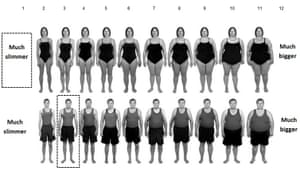


Mean mannequin sizes rated using the BMI-based body size guide rating scale.


Mean mannequin sizes rated using the BMI-based body size guide rating scale. Photograph: Eric Robinson

Our observation of male mannequin shows that there is no legitimate reason why mannequins used to sell female fashion have to be ultra-thin. If their male counterparts can be a “human” shape and size, then why can’t they?


Although some nation fashion stores say they are using larger bodied mannequins, we found no evidence of this in any of the stores that we visited. Of course, we can’t rule out that there may be some larger mannequins knocking about in a small number of stores, but we found that unhealthily thin mannequins are the norm on the high street.


Mannequins aren’t people, nor do they have a sign on them saying “you need to look like this”. But they are representations of the human body that are used to sell fashion and the idea of beauty. There is clear evidence showing that the ultra-thin ideal is contributing to the development of mental health problems and eating disorders.


There is no excuse for the continued use of emaciated mannequins.


Eric Robinson is a senior lecturer in the department of psychological sciences at the University of Liverpool.


This article was originally published on The Conversation. Read the original article.


Female mannequins aren"t just skinny, they"re emaciated

16 Ocak 2017 Pazartesi

6 Great Date Ideas That Aren’t “Dinner and a Movie”

Whether it’s your first date or your hundredth, you always want to make a good impression and have a fun day (or night) out. But, if the only ideas for a date that come to mind have to do with dinner and a movie, you need to be a little more inventive. Your date will appreciate something a little different and more inspired. Here are some date ideas to get you started.


Go For a Walk


If you’re looking to not break the bank for your date, consider going on a simple walk around town. Is there a nice downtown area you’ve been meaning to check out, or is there a river or other natural feature that would make for a peaceful atmosphere? Taking a walk with your date shows a little sense of adventure, and it allows for few awkward moments. There’s less pressure to make conversation, and you can always comment about the things around you.


Check Out the Museum


If you feel like have a more cultured date experience, you might do well to visit your local museum. Whether it’s art or history that you decide to learn about, there will plenty to see and experience at the museum, which will allow for many good conversation pieces. You’ll be sure to see an interesting side to your companion. The downside to this option is that you could come off as a little pretentious to your date, but if you just have fun with it, you could have a great time.


Browse Through a Bookstore


If you and your date are bookworm, why not head to the bookstore? It’s fun just to look at the different books you find, and talking about what you’ve read lately can be a great conversation starter, as well as a way to find common ground with one another. For a fun activity, consider picking out books for each other to read, or perhaps both decide on one book you can both read together. It’d be a book club of two!


Play Board Games at Home


Another cheap option for having a date night is to play some board games at home. This option gives you a bit more freedom with how you spend your night; for example, you could choose to have some drinks or make dinner together if you’re both at home. On the plus side, staying in can expose your date to your personality. After all, our homes are extensions of ourselves.


Spend the Night Stargazing


Almost nothing is as romantic as looking out at the stars on a clear, comfortable night. Looking out into the great beyond is sure to stir up some deep conversations, but be aware: that may be a little too heady for a first date. Bonus points if you research some constellations in advance to point out to your date, who’s sure to be impressed by your celestial knowledge. Make sure you bring a blanket to lie on!


See a Live Show


If you and your date are still itching for a little entertainment on your date night, consider attending a live event. There’s just more excitement in seeing something in person rather than on the screen. Just make sure you don’t spend too much on tickets; sites like Main Event Specials offer deals and coupons that you might not find anywhere else. A theater performance is a common date activity, but if you two are sports nuts, you could also check to see if your home team is playing. You and your date will be sure to find some connection if you’re both rooting for the same team.


Author byline:


John Matthew working as digital marketing expert since 2008, he started his career as social media professional with NTD Telecommunications. John played a vital role in developing following brands freecnaclasses.net and dontpayfull.com and much more. He loves to exercise, yoga, my twin daughters, dailyforex.com, encouraging quotes, sleeping in colder rooms, bunk beds, acne spot treatment, the internet, hiking shoes for women, web hosting and traveling to new places.


6 Great Date Ideas That Aren’t “Dinner and a Movie”

6 Kasım 2016 Pazar

Health secretary says NHS issues aren"t just about money but also standards

Jeremy Hunt sought to play down a row about the amount of new funding available for the NHS, saying the health service’s challenges are not “just about money”.


The health secretary was challenged by the BBC’s Andrew Marr over the gulf between the government’s claim that the NHS has been awarded an additional £10bn of funding, and estimates by independent organisations that have put the “true” figure at about £4.5bn.


Last month, MPs on the health select committee threw their weight behind the lower figure, with Tory parliamentarian Dr Sarah Wollaston warning the government’s £10bn figure “is not only incorrect but risks giving a false impression that the NHS is awash with cash”.


Last week, Nigel Edwards, the Nuffield Trust’s chief executive, warned: “The NHS is going into its toughest winter yet with the odds stacked against it. Demand for healthcare is on the rise, funding for both health and social care is being squeezed and A&E departments are missing their targets.”


Hunt dismissed a suggestion from Marr that the NHS’s performance was suffering because of a lack of funding: “We do tend to get in the run-up to the autumn statement a coalition of people who will say that the answer to all the NHS’s problems is more money from government.”


He said: “The big question is, does the NHS have enough money, and the answer to that is that we do need more resources – we are looking after a million more people aged over 75 than five years ago, that’s why we are putting in £4bn more.”


But he added: “It isn’t just about money – it’s also about standards.”


Ensuring that lessons were learned from medical accidents could help save the NHS on legal bills, Hunt said. “There’s lots of things we can do in terms of helping to ensure we are better at learning from mistakes, so that we don’t have this huge legislation bill of £1.5bn because of some of the mistakes we have made – that all helps on the money front.”


He added: “There are, of course, financial pressures, but I think it’s a mistake to say this is only about money. It’s also about getting the culture right.”


Winter is “extremely tough” for the health service, Hunt said: “I can say I think we are better prepared this year than we’ve ever been.”


But he added: “There’s always the unpredictable, the cold spells, the flu outbreaks and so on … I think it would be wrong for any health secretary in the run-up to winter to say everything’s tickety-boo.”


Health secretary says NHS issues aren"t just about money but also standards

31 Ekim 2016 Pazartesi

Health visitors aren"t valued but we do more than just weigh babies

Health visitors don’t always get good press at the school gates or toddler groups. Among my fellow nursing friends, the standing joke is that I spend my day simply weighing babies. I guess as a result it’s not hard to see why in some areas the value placed on health visiting has fallen so far that the service will be cut completely.


At the moment most councils are reviewing the funding for health visiting amid drastic cuts to public health budgets. Cumbria and Staffordshire are planning on cutting health visiting posts and a number of other NHS trusts have job freezes and have discussed redundancies. NHS Digital reported this year that the number of health visitors dropped in UK by 433 posts.


While perhaps there may be some truth in the comments I so often hear, the reality of health visiting feels very different.


It’s hard to describe a typical day because the one predictable thing is that it is completely unpredictable. I’m never quite sure when I stand at a front door what is going to be behind it. I have a bag full of leaflets and a mental checklist of the topics I’m expected to discuss. As the door opens, I may be greeted with a smile or an offer of a cup of tea, other times by indifference and occasionally with suspicion. Then there are the times when I’m not greeted at all, when I stand on the doorstep trying to find a pen, my diary and a free slot later in the week to return.


As I take a seat on the sofa, I’m aware of the balance I need to strike between raising topics and listening to what families need and want to ask. I don’t always get this right; I feel the pressure of sharing key messages about safe sleeping, coping with crying and infant brain development resulting at times in me talking too much and listening too little.


Within an hour of taking that seat I’m asking personal questions related to health, relationships and parenting. I explain that I ask these questions to everyone, issues such as mental illness and domestic violence are common and do not discriminate. But I won’t pretend that it doesn’t sometimes feel intrusive. I’m hoping that in that brief time I’ve built up enough of a rapport to make these questions powerful because when necessary it’s incredible how much someone can share with a stranger.


Sometimes as I look around the room the poverty and health inequality is obvious. Young children living in damp, mouldy, overcrowded houses. Sparsely decorated front rooms and kitchens lacking basic items many of us take for granted. At other times it’s more subtle. I see families struggling to feed their children during the school holidays because they have had to pay for extra childcare while they work; families having their benefits stopped because of an administration error; families where the main source of income is a zero-hours contract and if the phone rings at 6.30am, then there’ll be work. If it doesn’t there won’t and so today is another day of emergency electricity.


Within an hour of taking a seat I’m asking personal questions. I won’t pretend that it doesn’t sometimes feel intrusive


As I reach into my bag to find the food bank vouchers, the number for Citizens Advice or to make notes on the letter I’ll write to support a family’s application for being rehoused, I try to block out the thoughts that this isn’t enough. As I explain that my letter may not make any difference, that the waiting lists for social housing are so long most children will have grown up by the time they make it to the top, I try not to feel despondent that there is little I can do. As I reassure a mum that none of us are perfect, but she is good enough and explain that I can offer a listening ear and opportunity to access specialist support, it often feels like all I’m doing is putting a sticking plaster on a great gaping wound.


Before I leave, I explain how families can contact me, no question is too small. I’m there until their child goes to school, but unless there’s an extra need, I won’t visit again. I explain that I’ll be at a baby clinic at the local children’s centre every week. I don’t mention how the staff there are unsure about whether they’ll have jobs this time next year, and how the support they’re able to offer diminishes each week as cost savings are made to “streamline services”.


And as I close the door on my way out, I hope that I’ve not missed anything. I hope that the positive and upbeat mum wasn’t putting on a show because she’s scared of what may happen if she tells me how hard she’s finding life. I hope that I won’t get a phone call from social care in few weeks’ time about what’s happening behind that front door. Then I take a deep breath and get ready for the next doorstep.


If you would like to write a blogpost for Views from the NHS frontline, read our guidelines and get in touch by emailing sarah.johnson@theguardian.com.


Join the Healthcare Professionals Network to read more pieces like this. And follow us on Twitter (@GdnHealthcare) to keep up with the latest healthcare news and views.


Health visitors aren"t valued but we do more than just weigh babies

5 Ekim 2016 Çarşamba

Mental health social workers aren"t giving up hope, nor are their service users

I entered the field of mental health social work just a few weeks ago, joining a psychosis team. I had been warned by friends, family, taxi drivers and the media that this area of work is in dire straits and suffering hugely from cuts and poor practice.


After a couple of days, I could confirm that the former is true: swingeing cuts have had a drastic effect. Therapeutic groups and the time practitioners are able to spend with service users are incredibly stretched, and diaries no longer set aside any time for breaks – or, it seems, any time to breathe. However, my observations of current practice contradict the tales of woe.


I spent one day with a mental health support worker, shadowing him on four home visits with service users, and I was touched by the remarkable work he is doing. In the car between visits, we spoke about the value of things like listening, getting fresh air, and working collaboratively with each service user.


I had come across words like “collaborative” and “active listening” time and again in literature and legislation on mental health practice, but had pessimistically assumed that, for the most part, this language served to tick boxes for inspectors.


The support worker valued the time spent with each service user as much as they did with him


Here, I witnessed these things being practised in the truest, most genuine sense. The support worker valued the time spent with each service user as much as they did with him, and I observed them continuously teaching and learning from one another.


This was not in an expensive psychiatric unit or over a £4 coffee, but simply during walks, exploring new areas and the changing seasons, discovering the best places to go. It occurred to me that so much essential work, even administrative obligations, could take place in these settings. Why not?


Understanding of what good practice means is changing, and mental health finally seems to be taking centre stage in public discourse.


Unfortunately, because these changes have taken place in the era of austerity, many ideas about the value of a social approach feel unfeasible in practice. As a result, a return to a medical model is tempting, and can seem like the most time-saving and cost-effective option. However, from what I have seen, expensive medication with often complex side effects, compares poorly with therapeutic support.


Medication is undeniably an important part of recovery for some service users, but the knowledge that they have been prescribed drugs to alter their thoughts automatically places them in a category of “in need”, or in some sense “less human”.


The social work I have observed is therapeutic input at its best. Despite the challenges ahead – inevitable in every job – I am so grateful that the negative attitudes towards the field of mental healthcare are being challenged and contradicted in daily practice. Workers, such as the people I’ve met, are not giving up hope, and as a result, service users are not giving up hope either. This, to me, is the greatest outcome we could wish for.


The Social Life Blog is written by people who work in or use social care services. If you’d like to write for the series, email socialcare@theguardian.com with your ideas.


Join the Social Care Network to read more pieces like this. Follow us on Twitter (@GdnSocialCare) and like us on Facebook to keep up with the latest social care news and views.


Mental health social workers aren"t giving up hope, nor are their service users

5 Eylül 2016 Pazartesi

Italy’s Fertility Day posters aren’t just sexist – they’re echoes of a fascist past | Annalisa Coppolaro-Nowell

Italy woke up last week to a series of offensive images that could have been published in the 1930s, including the slogan “Beauty knows no age. Fertility does.” They were sexist, ageist – and promoted by the government and health minister Beatrice Lorenzin to publicise 22 September, which it has designated Fertility Day. On this day, people will be able to “get more information” on how to procreate and be happier, which, as the bestselling author Roberto Saviano puts it, offends “all the people who don’t have children and those who would like to have some but can’t because there is no work in Italy”.


According to the official website: “The first Fertility Day will be celebrated to attract attention to the topic of fertility and its protection,” and “to underline the danger of falling birth rates in our country”. It also says it wants to focus on “the beauty of maternity and paternity” and “medical help for those people who are having problems conceiving”. The site offers information about how Italian regions will be involved, with doctors, pharmacists and clinics available to give advice to those interested in the subject of procreation. And in four major Italian towns – Rome, Bologna, Padova and Catania – there will be events to promote fertility and discussions on the subject.


In the 1930s posters on the walls incited women to give more children to the fatherland


In and of itself that might not have been cause for such a furore – but what has ignited anger is not just the idea of procreation as a matter for the state to intervene in, but the images associated with it: a series of photos of pregnancy, and some troubling adverts, such as one where a woman holds an hourglass to show that her biological clock ticking away.


The reaction has been fierce, with many questioning if there is not a better way to encourage people to have children – by promoting employment policy, for example, and by helping the economy to grow more after many years of recession. Only in the last six months has Italy started to recover from a long period of economic trouble. But growth is slow and unemployment is still very high – over 40% – among the under-25s.


It’s that age group that also feels put out . One of the slogans, “reproducing is the best way for young couples to be creative”, has been roundly condemned by many newspapers including La Repubblica, La Stampa and even Il Giornale – with headlines such as “The web attacks the health minister for her slogan: We need to make more children.”


But it is the use of the images and what they say about the place of women in Italy that has offended so many people, including those who choose not to have children for their own reasons. Why should they be discriminated against? The recent law on civil unions approved by the Italian parliament a few weeks ago gave many the impression that the state had finally accepted a broader idea of the family, but now this campaign puts the emphasis back on discrimination. Women are targeted by this fertility campaign, as if they were the only people responsible for the declining birthrate that has been affecting Italy for many years.


It all sounds so similar to the fascist slogans of the 1930s, when posters on the walls incited women to give more children to the fatherland. Many cannot believe that a female minister has launched such a sexist, ageist, anachronistic campaign in a country where many other urgent problems remain to be addressed.


Italy’s Fertility Day posters aren’t just sexist – they’re echoes of a fascist past | Annalisa Coppolaro-Nowell

28 Mayıs 2014 Çarşamba

Abortion: why aren"t men allowed to have a say?

Where the woman says that the pregnancy is the result of rape, she would have to provide a police report as evidence before she could have the abortion.


Heavy sanctions would back up these provisions. A woman who forges the signature of an alleged father and a man who falsely claims to be the father in order to help a woman in getting an abortion would both be subject to criminal prosecution – as would the doctor who performs an abortions without the written consent of the father.


Wow! The Ohio bill is, apparently, very unlikely to pass into state law; but even if it is not going to shake our earth it looks, at least, as if it might be a straw in the wind. In its unequivocal radicalism, it eclipses all previous attempts to assert any rights of men in abortion.


I thought I was being daring in my 1992 book No More Sex War when I wrote:


“Women who choose to have an abortion might be a good deal better off if their men were required to endorse and support their decision. If the man agrees, the burden of the decision will be shared. If the man does not agree, he ought to be provided with a means to say so. His opinion ought, at least, to be registered and recorded. I’m not saying it ought to have any restraining force in law. I’m not saying a woman should be prevented from having an abortion if the father disapproves. I’m just saying he has a right to be heard.”


These tame suggestions got me hauled over the coals of the feminist orthodoxy on my way to a pelting in the stocks. Not for the first time. When, in 1989, The Times published a column of mine in which I mourned the absence of two aborted children whom I might have fathered, the paper received so many letters in response that they had to be run on full half-pages on consecutive days. Nineteen out of 20 of those correspondents furiously told me that, as a man, I had no right to express any opinion on abortion and I could keep my feelings of loss to myself.


When my book was published, I was summoned to the cellars of Broadcasting House for an inquisition at the hands of that Torquemada of Woman’s Hour, Jenni Murray. “A woman’s rights over her own body must be indisputable,” she thundered. “OK,” I answered. “But they are not the only rights at issue in a pregnancy” – a proposition which, to my surprise, she seemed to accept without demur.


That’s the bottom line. The woman’s right to choose is, obviously, not the only concern – despite the fury with which feminists have been insisting on that position for 50 years.


On top of the highly contentious question whether the foetus in the womb has philosophical, moral and legal rights which place a duty of care on the wider society, the inseminating man must clearly, undeniably have an active interest which ought to be established and recognised with legal rights. And then, too, the wider society which pays for the operation under the NHS in Britain should also save a say. Is it in the interests of taxpayers that 150,000+ abortions should be performed every year? Is it in the interests of the wider society that those lives – more or less equal to the annual figure for net migration in the UK – should be stilled?


Or are those questions only allowed in Ohio?


Abortion: why aren"t men allowed to have a say?

30 Aralık 2013 Pazartesi

Cold reality: humans aren"t as resilient as Exmoor ponies | George Monbiot

Exmoor Pony foal

‘I believed of Exmoor ponies and the way they stand with their backs to the rain until it passes. If they could do it, so could I.’ Photograph: Alamy


It was a gorgeous morning, a Saturday in October, and I was obtaining tea with my subsequent-door neighbour. We started speaking – for this was almost 20 many years ago – about the street the government meant to create all around the town of Newbury, some thirty miles away. When the machinery moved in we planned to join the protests. Men and women had been presently starting up to create platforms in the trees. “Let us go down and consider a search.”


A train was due to depart in half an hour. We threw sleeping bags and warm outfits into our pannier bags, jumped on our bikes and sprinted to the station. We arrived just as the train was leaving. “Why do not we just cycle there?”


We had missed our breakfast and had no foods or water, but there have been bound to be stores or pubs along the way. We would maintain off the roads as considerably as attainable, following bridleways and footpaths.


At initial we sailed along, feeling buoyant and free of charge. It was one of those autumn days in which the sky appeared cleaner and brighter than at any time for the duration of the summer season. Then the paths started cutting across fields which had recently been ploughed, and our urban bikes grew to become snarled up with mud. A pregnant grey cloud blotted out the sun and hail started pelting down. This was the stage at which my pal discovered that his raincoat, which had been clipped to the prime of his bike rack, had fallen off. He went back to search for it. I made the decision to wait in the discipline.


The hail soon turned to rain. I was even now steamed up, so it felt refreshing as it soaked into my T-shirt. Soon after a while I began to come to feel a tiny cold. But – and this is the nail of idiocy on which the story hangs – I imagined of Exmoor ponies and the way they stand with their backs to the rain until it passes. If they could do it, so could I.


By the time my friend returned I was shivering. But I was reluctant to alter my outfits, as I knew we would quickly get sizzling again crossing the fields. The rain had ceased, but now our bikes slithered across the moist path. By the time we hit firmer ground I was extremely hungry. I was stunned to discover that I was nevertheless shivering.


We rode more than the downs to a village in which, we have been sure, there would be a shop. There wasn’t. The pub was shut. No matter, we would eat in Newbury. By the time we reached a prolonged slope major up to the Ridgeway – the neolithic path that traverses southern England – I had ceased to really feel both cold or hungry. Thoughts over matter, I informed myself I had triumphed more than discomfort.


But there was something incorrect with my bicycle. The wheels would not go round. I turned the bike in excess of and identified to my surprise that they spun freely. I started out pushing it up the hill, but once more it seemed to be snagged. My friend gallantly provided to swap. But there was anything incorrect with his bicycle as well. It felt absurdly hefty, and the wheels also seemed to be jammed.


We remounted when we reached the Ridgeway. Even on the level track I could scarcely force the pedals round. We reached the metalled street, and I sat like a pudding as we freewheeled down a shallow slope. Then I gradually toppled off the bike. I stumbled backwards into the hedge beside the road, where I lay spreadeagled.


“Are you all right?” “I’ve in no way felt far better. But I cannot truly move,” I stated. I felt as if I were lying in a warm bath. I could move my mouth and eyes but little else. I had never experienced this kind of deep peace.


“Um, I believe we need to get some help,” my good friend ventured. “No actually, I am fine.” My friend, who is not renowned for his assertiveness, stood by the street, half raising a hand to the passing site visitors: “Um, excuse me … Would you mind …” I watched with amusement as the cars whizzed previous. Then a big black point stopped and a blond giant stepped out. He was dressed in black, he had a crewcut and muscle tissue everywhere. He brushed past my pal and seized me by the shoulders.


“What is your name?” “George.” “What is your name?” “I just informed you – George.” “What is your title?!” Who was this rude guy, I wondered, and why could not he just depart me alone? He turned to my pal. “What have you got in your bags?” “Um, sleeping bags, coats.” “You happen to be carrying sleeping bags and he’s – fuck, I have witnessed it all now.”


He pulled out a sleeping bag, lifted me up as if I had been a cat and dropped me into it. “What’s your name?” “I just advised you.” “Shut up! What’s your identify?” He walked into the street, his great hands raised to the visitors. The first auto stopped. “Chocolate, sweets, what ever you’ve acquired.” Terrified, the girl in the car scrabbled in her bag, then handed him a bar of chocolate.


He returned to me. “This is very variety of you, but I am really all proper actually.” “Shut up! What is your title?” He started feeding me the chocolate. It was plainly safer to obey than to resist this madman, so I ate it. He named the ambulance. “Truly, there is no need to have …” He stopped far more autos, forcing them to disgorge a pile of sweets and chocolates. “I never have a lot of a sweet tooth to be honest…” “Shut up! What is your identify?”


The ambulance arrived. They wrapped me in a room blanket and took my temperature. They appeared to be creating a terrible fuss about practically nothing. The black vehicle drove away. They place the sirens on and stored making use of the thermometer: my temperature had fallen, I was later on told, to half a degree above the level at which they would have misplaced me.


In hospital the nurse told me I would need to have “the total treatment method”. “No. What?” “Sizzling chocolate and toast and honey.” Half an hour following I had arrived, I sat up and swung my legs off the bed: out of the blue fit and well and buzzing with sugar. It took me a number of hours to realise that the blond giant (we guessed he was an army paramedic) had saved my lifestyle.


Cold reality: humans aren"t as resilient as Exmoor ponies | George Monbiot